See here for more stories of Lisnavagh
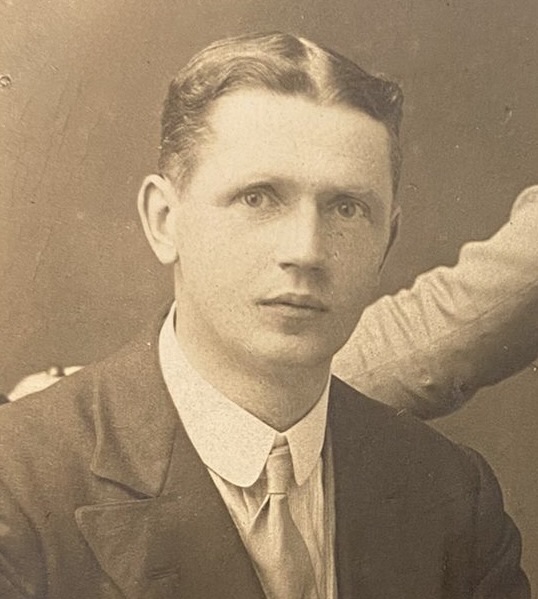
Walter Wood (1880–1953), the Rathdonnell chauffeur.
Walter’s Paddock at Lisnavagh, County Carlow, is named for Walter Wood, who served as Lisnavagh chauffeur for about half a century. He was a son of Gilbert Wood, a gardener, and his Dublin-born wife Clara (née Percy). [1] He seems to have been the eldest child, his younger siblings being Gilbert, Jane, Clara Elizabeth (known as Bessie?), George, Ada, Mary/Pollie and Alexander (Alick / Alex).
Walter seems to have been a little indecisive about where he was born. On the 1901 census, he gave Meath; in 1911, he stated Dublin; in 1926, here, he specified Dundrum, County Dublin. However, his family believe he was born at the Hamwood estate near Dunboyne, County Meath, on 14 January 1880. He was baptised as a Church of Ireland Protestant at St Peter’s Church, Dunboyne, on 28 March 1880. [2]
Hamwood, County Meath
Gilbert Wood, Walter’s father, was born circa 1861. Echoing his son, he also gives dual answers for his birthplace. On the 1901 and 1911 censuses, he states Longford. A quarter of a century later, when he filled out the 1926 census, he gave it as Newcastle in England.
Gilbert was working with the Hamiltons of Hamwood by the time Walter was born in 1880 and he was still there when his eldest daughter Janie was born in about 1883. Charles Hamilton was agent to the 4th Duke of Leinster at this time. The duchy would enter a deeply turbulent period in the 1890s.
There is a record of a George Alexander Wood, a labourer’s son, who accidentally drowned at Hamwood in 1888, when he was not quite two years old. It seems likely this was Walter’s younger brother. An inquest was held on 13 July 1888.
Ballaly Park
In terms of locations, it should be noted that Gilbert and Clara Wood had another child born on 21 September 1882 and named elsewhere as Gilbert Fitzgerald Wood, perhaps a nod to the FitzGerald family, of which the Duke of Leinster was the head. His place of birth was given as Ballaly Park, which is located near Dundrum and and Sandyford in County Dublin. According to Thom’s Official Directory, 1882, p. 916, the resident/occupier of Balally/Ballalley Park in 1882 was Robert Mansell, solicitor, also listed at 11 Merrion Square South. By the following year the spelling appears as Ballawley Park, and the listed occupant seems to have changed to Edward F. Burke, so 1882 may catch a transition in occupancy or directory usage.
Blackhall, County Louth, & the Pentlands
At some point between 1883 and 1901, Gilbert moved to Blackhall, near Termonfeckin, County Louth. It is likely Gilbert worked for the local big house, which was home to George Henry Pentland (1849-1932), a barrister and land agent, his 41-year-old wife Jessy Frances Pentland (1857-1929), née Barrington, as well as a coachman, cook, waitress and housemaid. Blackhall was built c.1790 and completed by an earlier George Henry Pentland (1770-1834), a Dublin solicitor who bought the lease in 1815. (One of the Pentlands sailed with Napoleon to St Helena, here.) It is possible the Wood family were there by 1892 when the younger G. H. Pentland became acting secretary (and co-founder) of the newly established County Louth Golf Club.
The Woods were certainly at Blackhall by the time of the 1901 census when Gilbert (aged 40, gardener) and Clara (aged 41) were recorded there with their five younger children, namely Janie (18, gardener’s daughter), Bessie (15), Ada (11), Pollie (9) and Alick (7). [Walter was by then in Castleblayney, see below.] Janie, Ada and Pollie were all born in Meath, Bessie in Dublin and Alick in Louth. Those birth locations may help track Gilbert and Clara’s movements between 1883 and 1894.
By 1901, the older Wood sons Walter and Gilbert both seem to have been in County Monaghan. Walter, as noted in more detail below, was at Castleblayney, while Gilbert may have been the 17-year-old Gilbert Wood recorded as a groom with the Haire-Foster family at Ballynure, a stone’s throw from where Ally and I were wed in 2006.
Tragically, Clara was institutionalised at the Richmond District Lunatic Asylum in Grangegorman in north inner Dublin, sometime between the 1901 census and her death, aged 44, on 12 January 1905. Located on the old House of Industry / Grangegorman institutional site, it later became Grangegorman District Mental Hospital and then St Brendan’s Hospital. The cause of death was given as ‘Exhaustion following acute mental excitement‘. On her death certificate, here, she was described as the wife of a labourer. The poor woman had not been alone: on 25 September 1905, the Inspectors of Lunatics reported 2,817 patients resident in the two asylums of the Richmond district, made up of 1,499 in Richmond / Grangegorman and 1,318 in Portrane.
Gilbert was 51 when he filled out the 1911 census form, here. He was still a gardener at Blackhall and living with his 28-year-old daughter Jane and 17-year-old son Alex, now a stable groom. Gilbert also noted that he was ‘deaf’ on the census form. The rest of his children had scattered. For instance, Ada Wood, now 22, was then working as a domestic servant for Elizabeth Robertson, a widow and farmer, at Oldtown Deerpark at Fruithill on the outskirts of Limavady, County Derry. [3] There is no record of the younger Gilbert; it is said that he emigrated to America and died there in 1959.
In the autumn of 1922, the Pentlands departed Blackhall and relocated to Shalford, Surrey, England. They were probably much traumatised by the killing of Jessy’s young niece Winifred Frances Barrington on 14 May 1921; she fatally wounded in the IRA’s Coolboreen Ambush of District Inspector Harry Biggs of the RIC, with whom she was travelling near Newport, Co. Tipperary. Added to this George’s motor car was seized by armed men on 3 May 1921 and, while it was returned times, it was also badly damaged.[4]
The Thunder Era
On 2 October 1924, Robert B Daly, the Drogheda auctioneer, hosted a major sale of Blackhall’s furniture.[5] The Pentlands had sold the house to Captain Francis Thunder, a Catholic farmer from Balbriggan, and youngest son of Michael Thunder, DL, of Lagore.
Gilbert Wood continued to live there, being recorded on the 1926 census, here, aged 66. He was living with his unmarried eldest daughter Janie, now 38, who gave her place of birth as Hamwood and her occupation as housekeeper. Walter specifically stated that he was working as a gardener for Mrs Thunder, who held about 80 statute acres. The 1926 census (here) records Captain Thunder and his 42-year-old wife Adelaide living at Blackhall with three servants: Margaret Comerford, Ellen Donnelly and Lillian Warren.
Francis Thunder died at Blackhall on 15 April 1928:
‘… under rather tragic and sudden circumstances … he had been about as usual during the day and after visiting the Catholic Church at Termonfeckin on Saturday afternoon proceeded home by motor and took suddenly ill and died. The news of his early and unexpected demise created consternation and deep regret amongst the immediate community as the deceased was of a very charitable disposition and during the great coal Strike last year he supplied fuel amongst the working class residents of Blackhall where he has been resident for about 3 years.’ [6]
After funeral mass at Termonfeckin, he was buried at Ratoath. [7] He left £6,000 in personal estate.
Adelaide, known as Ada, was born in Argentina. Two years after her husband’s death, Mrs Thunder presided when a Branch of the United Irishwomen’s Society was formed at Termonfeckin, in 1930, with Lucy Franks as hon. sec. and Vida Lentaigne as one of the vice-presidents. ‘Miss L. Franks, hon. sec. of the Society, said their aim was to bring women in rural places together and to form centres where they might meet for social intercourse, work and recreation, Mrs. Sheridan was elected president, and Mrs., V. Lentaigne and Mrs. Malone vice-presidents.’ [8]
When she died in 1952, Ada left Blackhall to her closest living relative, Lucita Parmiter, ‘a tall striking woman, very athletic [who] enjoyed skiing on the continent, even in pre-War days.’ She was wife of Geoffrey de Clifton Parmiter, MBE, who died in 2001. A barrister, Geoffrey wrote a book about Roger Casement from the legal point of view. The Parmiters only lived at Blackhall for about a year before they sold and relocated to London. [9]
A Royal Duke’s Gardener, perhaps …
21-year-old Walter Wood was recorded on the 1901 census as a gardener in Castleblayney, County Monaghan. The big house at ‘Blayney’ was Hope Castle, owned by the Hope family. In 1901. it was occupied by the Duke and Duchess of Connaught and their children. Their daughter Princess Margaret of Connaught later became Crown Princess of Sweden. The duke was Queen Victoria’s son and, if memory serves, Lady Leslie of Castle Leslie, County Monaghan, was his mistress.
Lisnavagh – The Chauffeur and his Mandolin
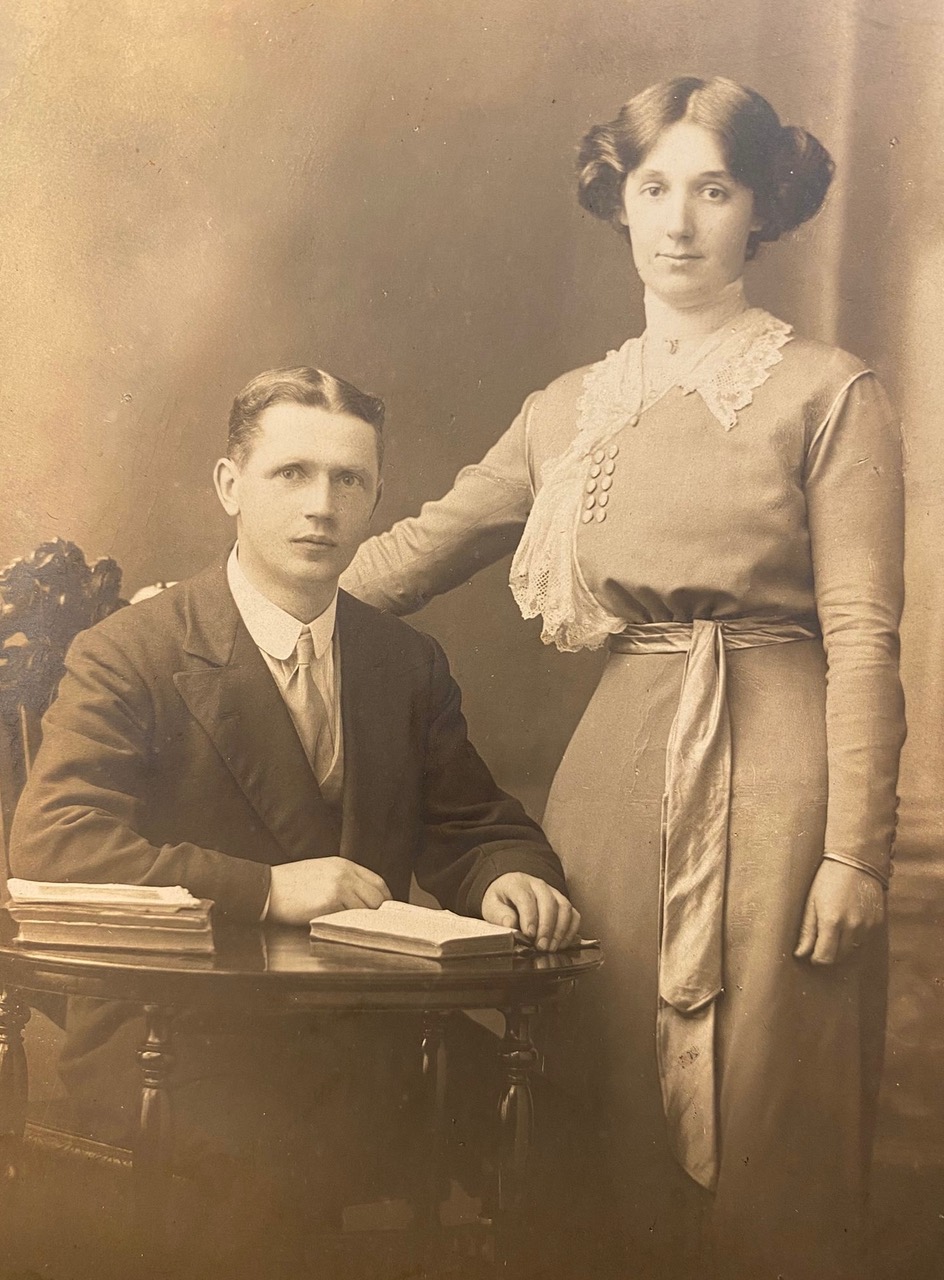
Walter Wood and his wife Susan, née Campbell. at the time of their wedding in Armagh in 1913.
Our father was of the view that Walter started at Lisnavagh as one of eight gardeners working for Thomas Kane McClintock Bunbury, 2nd Baron Rathdonnell. A report in an Irish Times article relating to a traffic incident involving Lord Rathdonnell’s car in 1922 noted that Walter had been in the Rathdonnells employ for 14 years at the time, i.e. 1906. However, the earliest definitive record we him of him at Lisnavagh is two years earlier than that. It concerns a mandolin that he advertised for sale in the Irish Independent on Saturday 20 February 1904, p. 8. The ad ran:
MANDOLINE, butterfly sound board, pearl inlaid, beautiful little instrument, suit a lady; 19s, in use; approval. Walter Wood, Lisnavagh, Rathvilly, Co. Carlow
How did he get from Castleblayney to Lisnavagh? Who knows, but Blackhall is roughly 7 km / 4.4 miles as the crow flies from Drumcar, the Rathdonnell house in County Louth, so perhaps his parents tapped into a local network to get him an interview. In any case, having started in the Lisnavagh garden, it seems, in Dad’s words, that Walter ‘showed some mechanical or engineering ability, and was deemed the most suitable and mechanized to become a chauffeur.’
On the 1911 census, 30-year-old Walter Percy Wood, chauffeur, was staying with seven other primarily Ulster-born Protestant “servants” at Oak Park, the home of old Henry Bruen outside Carlow town. On this form, he again gives his place of birth as Dublin. Perhaps he was simply over-nighting at Oak Park when the census was taken. Henry Bruen’s son Arthur was land agent at Lisnavagh at the time while his daughter Kate was Lady Rathdonnell.
Walter was again listed at Lisnavagh in the Irish Motor Directory & Motor Annual of 1911-1912, edited by Henry G. Tempest, albeit with a bicycle. A motorcycle with the registration number IC 49 was registered to Walter at Lisnavagh in 1911 but cancelled ‘by direction of the owner’ on 30 December 1912.
His timing coincides with the life of Tom Branson, the Irish chauffeur in Downton Abbey. Tom’s date of birth is given as 27 September 1885 and he arrives at Downton as chauffeur in 1913.
Marriage to Susan Campbell
Walter had another good cause to visit Oak Park as the same 1911 census lists 31-year-old Armagh-born Susan Jane Campbell as one of the Bruen’s housemaids – and she went on to become his wedded wife. She was born in Drumilly, County Armagh, in February 1880, a townland on the southside of Loughall. [10]
Walter and Susan were married in Armagh in December 1913. My father recalls Susan, with whom Walter lived in the Laundry House at Lisnavagh, now home to William and Heather Dick. ‘When I was a child, it was a glory of lovely flowers, most unusual in those days,’ wrote Dad. The field across the road from the Laundry House is the one known as Walter’s Paddock.
Their only daughter Olive Cicely Wood was born at Lisnavagh on 9 January 1923. The family lived at the Laundry House up until Susan’s death in 1955 but I am unsure when they first moved into it. Our father recalled that it had ‘a magnificent garden, which was most uncommon in that time.’
Prisoner-of-War?
The Wood family archives contain the following letter sent by King George V (R.I.” = Rex Imperator, King Emperor) from Buckingham Palace to an unnamed returning British serviceman in 1918. The recipient was a prisoner of war (POW) who had just been repatriated or released. The letter was probably a printed or semi-printed ceremonial message distributed to many returning POWs rather than a handwritten personal correspondence. The question is, was it connected to Walter Wood and, if so, was he a POW? I have not yet found any clues of his war record:
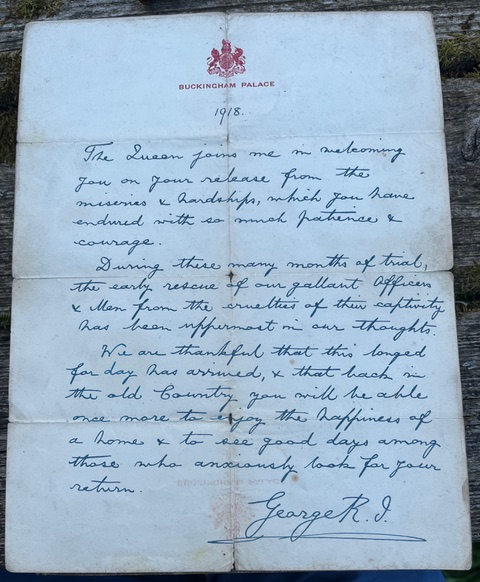 BUCKINGHAM PALACE
1918
The Queen joins me in welcoming you on your release from the miseries and hardships which you have endured with so much patience and courage.
During these many months of trial, the early rescue of our gallant Officers and Men from the cruelties of their captivity has been uppermost in our thoughts.
We are thankful that this longed-for day has arrived, and that back in the old Country you will be able once more to enjoy the happiness of a home and to see good days among those who anxiously look for your return.
George R. I.
I found no definite record that Walter Percy Wood was held prisoner. The ICRC First World War POW index, which is the key digitised source for WWI prisoner cards, did not show any full-name entry for “Walter Percy Wood,” “Walter P. Wood,” “W. Percy Wood,” or “Percy Wood”; the only unresolved possibilities were two Artillery cards for “WOOD, W.”, both with initials only and no biographical details to prove or disprove a link to him (ICRC First World War POW index). There is, however, one military-looking record with the right initials: the London Gazette records “Temp. 2nd Lt. W. P. Wood” moving from the Hampshire Regiment attached list to a temporary second lieutenancy and acting lieutenant appointment on 29 December 1916. That notice does not say he was captured, repatriated, or a prisoner of war, and it may or may not be our Walter Percy Wood. If he is the Gazette’s W. P. Wood, then officer records for Hampshire Regiment attachments may clarify whether he was ever captured.
The Unfortunate Affair of 1922
The report on the 1922 prang suggests he was chauffeur from before the war, so let us get the unhappy business of Thomas Carroll’s mangled bicycle out of the way. The Irish Times published the story on Saturday, November 18, 1922, p. 8:
GRAFTON STREET SMASH – LORD RATHDONNELL SUED.
Yesterday, before Mr. Justice Samuel, sitting without a jury, the case of Carroll v. Lord Rathdonnell was heard. It was an action brought by Mr. Thomas P. Carroll, No. 1 St. Dolomph’s terrace, Ranelagh, against the Right Hon Thomas Kane McClintock Bunbury, Baron Rathdonnell, of Lisnavagh, Rathvilly, Co. Carlow, to recover damages for injuries to the plaintiff’s bicycle and other expenses sustained by the plaintiff by reason of the alleged negligence of the defendant, his servants or agents in the driving and management of a motor car in Grafton street, Dublin, on the 3rd of June last.
The case for the plaintiff, an employee of the Singer Machine Company, was that on the afternoon of the 3rd June he was riding his bicycle and dismounted at the corner of Nassau street and walked across by Yeats’s. While he was on the roadway close to the footpath rolling the bicycle it was suddenly dragged from his hands and fell in front of the motor. The wheels went over the bicycle. Lady Rathdonnell and another lady, he stated, were in the car and the driver were in the car, which was open. He lost £2 a week by not having his bicycle, which had been smashed up by the accident.
For the defence the alleged negligence was denied. The driver of the motor car, Walter Wood, who has been 14 years in Lord Rathdonnell’s employment as chauffeur, stated that he came out of Suffolk street and crossed Grafton street at a speed of less than walking pace, not more than a mile an hour. Just as he got to the left-hand side of Grafton street nearly opposite Suffolk street, the plaintiff, who was leading his push bicycle, came into contact with his left wheel. The bicycle fell and the left front wheel of the car went over it.
Mr. Justice Samuels gave the plaintiff a decree for £11 4s. 6d., being 10 guineas damages and 14s. 6d. expenses. He pointed out that it was the duty of the car following the walking bicycle to keep clear of it, and remarked that the unfortunate accident was one of those things that would occur on the best regulated street and to some of the best regulated motor cars and bicycles.
Mr. H. Hamilton (instructed by Mr. A Lane Joynt), appeared for the plaintiff; and Mr. John Bartley (instructed by Messrs O’Neill and Collins) for the defendant.
The case played out against the backdrop of a time in which Arthur Griffith died, Michael Collins was assassinated and Erskine Childers was executed. Perhaps Walter drove Rathdonnell to Arthur Griffith’s funeral.
In any case, Walter kept his job and proudly stated his profession as private chauffeur to Lord Rathdonnell on the 1926 census.
The Rolls Royce Course

The Rolls-Royce which stood at Lisnavagh from 1937 to c. 1961. The 1929 Rolls-Royce 20hp Coupe was supplied new to first owner Arthur Donn Esq with Victor Broom Saloon coachwork but apparently rebodied by Barker as a Fixed Head Coupe during 1931 (whilst still in Donn’s ownership.) I’m not quite sure when the 4th Baron Rathdonnell acquired it.
At some point, Walter was dispatched to the Rolls Royce works in Derby to do a (three week?) course in maintenance at the School of Instruction. It was quite normal for owners of Rolls-Royce cars to send their chauffeurs to the school in the 1920s and 1930s. It opened in Derby around 1912, was revived after the war, and later moved to Ewell in Surrey in 1925. Dad was quite sure it was Derby so it seems likely he completed the course before 1925.
The training was not merely “driving lessons.” A Rolls-Royce chauffeur in that era was expected to be part driver, part mechanic, part valet, and part household servant.
Typical instruction included:
- Advanced driving technique:
- ultra-smooth acceleration and braking
- silent gear changes
- hill starts
- maneuvering large limousines in tight spaces
- high-speed control on poor roads
- passenger comfort above all else
- Mechanical maintenance:
- ignition systems
- carburetor adjustment
- lubrication schedules
- brake adjustment
- roadside repairs
- diagnosing faults by sound and feel
- Daily servicing routines:
- polishing and coachwork care
- tire inspection
- cleaning leather and wood interiors
- preparing the car before journeys
- Chauffeur etiquette:
- opening doors correctly
- handling luggage
- personal appearance and uniforms
- discretion and deportment
- interacting with aristocratic households
- Emergency and touring skills:
- driving in snow or mud
- first aid
- long-distance touring logistics
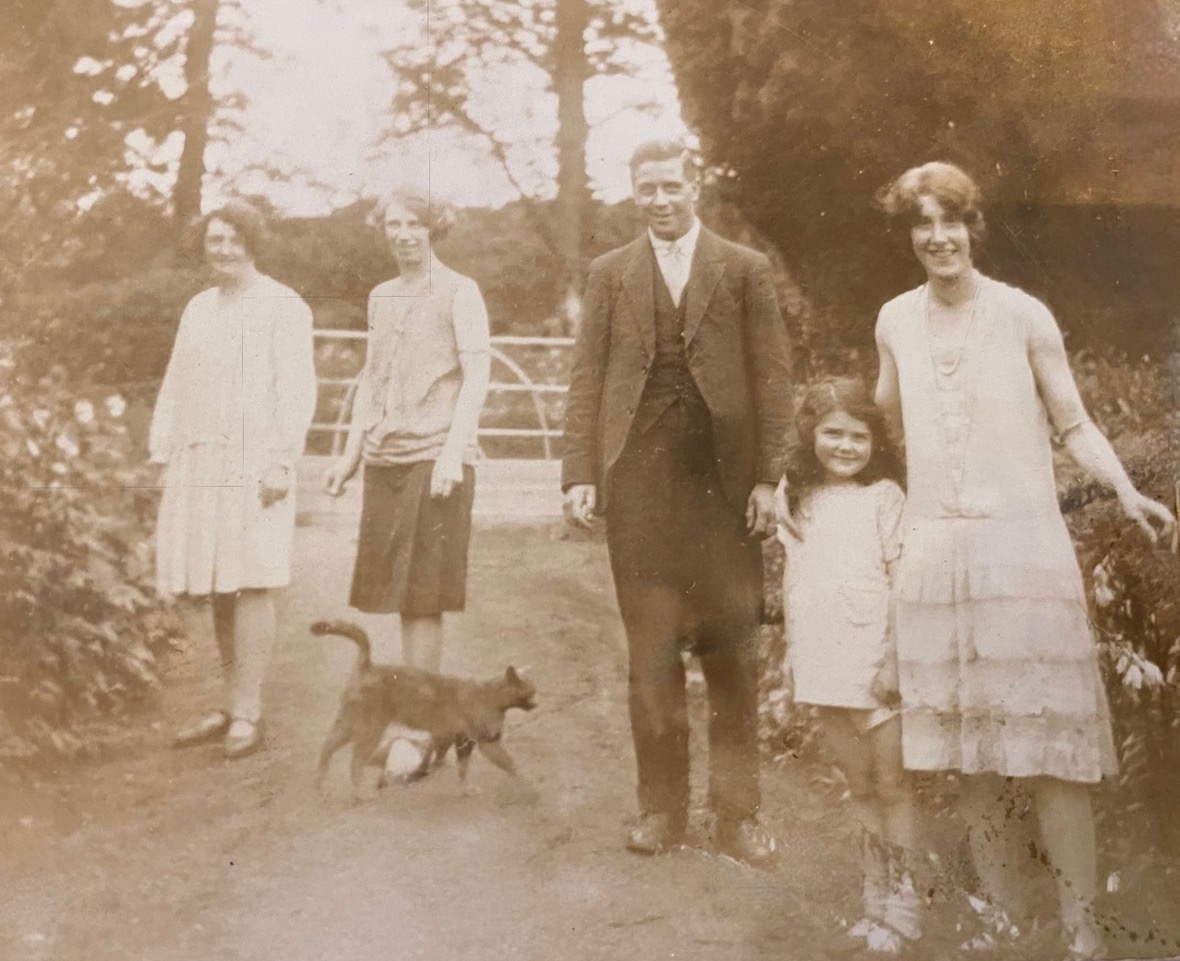
Walter and Susan, right, with young Cicely, circa 1930. I am unsure who the two women on the left are. Is this at the entrance to Laundry House?
Contemporary accounts and later recollections mention exercises designed to cultivate the famous “magic carpet” Rolls-Royce ride quality — for example driving without spilling water or champagne placed in the rear compartment. Certainly, his skills would impress Rosebud who had fond memories of travelling with Walter in the Rolls, or the ‘Rolling Pin’ as she called it, in the mid-1950s.
‘Walter was a sweet man and managed to drive Nanny and I around without making me that car sick, which was either due to his excellent driving or the suspension of the Rolling Pin! (I was one of the worst car sick people ever to travel this earth…getting to Carlow was a challenge, thus I was taken to very few places unless Force Majeur intervened in the form of dentist visits etc!!!)’
There were two cars at Lisnavagh at this time – the Rolls and a Ford van. ‘When not tinkering with the cars,’ wrote Dad in 2013, ‘Walter became a sort of “fixit” which he did from a large workshop on the north side of the Stable Yard, now the smart bedrooms numbered 2 and 3. These were the stables destroyed by a fire lit by a small boy (not me) in the early days of 1976.
Dad recalled that he also ‘did much useful making and mending about the House in his semi-retirement, as well as teaching Master Ben a few tricks. Apart from metal and timber repairs, he converted most of the house lamps from gas to electricity in 1952 – standards, wall lights, chandeliers, the lot.’
He was a vestry man for St Mary’s Church, Rathvilly, from at least 1934 until 1953.
Dad also recalled how he ‘gained favour’ from Walter by asking if he could accompany him to some motor races:
‘When I was with Walter in his workshop, we hatched a plot. I approached my father with a request to go to the Curragh races on Saturday.
“There is no racing on Saturday,” he retorted. “It is at Baldoyle.”
“Not horses, motor cars” says I, “Walter say he will take me”.
So it was that he and I set off in the van for the point on the Curragh, which is now Junction 12 on the M7; back then it was a sharp bend where the racing cars passed on their way from the Camp towards Kildare. I cannot remember whether we had a racecard but there was a small crowd there and Walter seemed to know what was going on. Every few minutes another noisy car sped round the bend; there were no mishaps, probably as well since I do not recall any protection for the viewers. One wonders now could one of them have been Dudley Colley? On the journey home we stopped, possibly at The Priory, where Walter kindly gave me a glass of pop whilst he had a whiskey!’
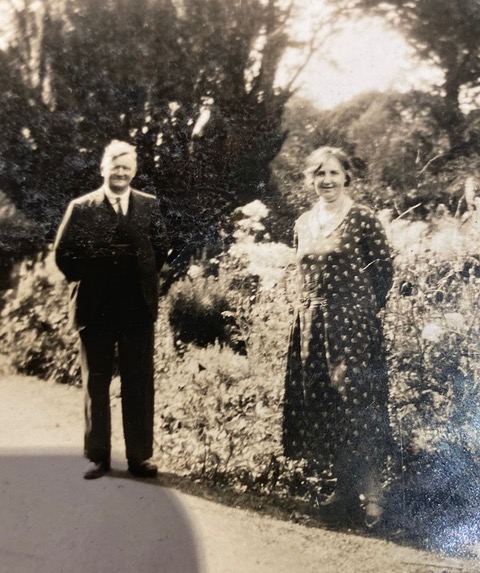
Walter and Susan at Lisnavagh
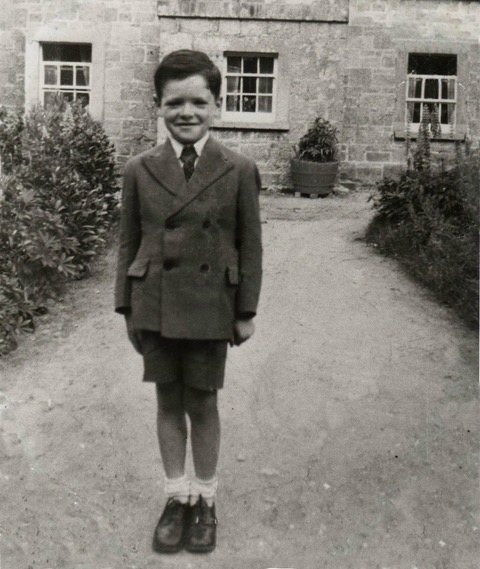
Liam Norris outside Laundry House, 1955
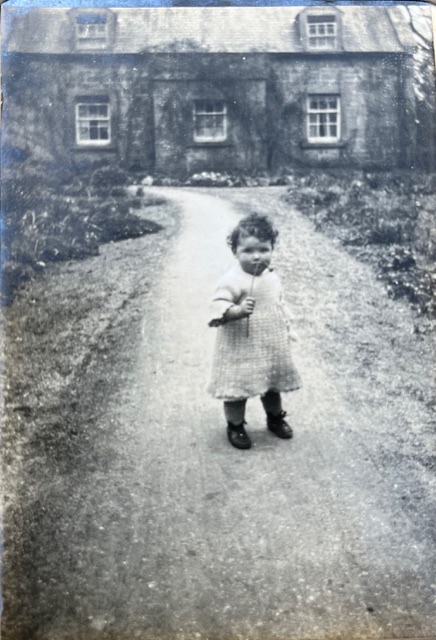
Cicely Wood outside Laundry House, c. 1927.
After Susan died on 20 March 1955, Walter relocated from the Laundry House to a small room in the North West Passage of Lisnavagh House, incorporated into William and Emily’s kitchen in circa 2015. (The room was also Dad’s office for a while in the 1960s). This is the room where he spent his last days. ‘My last memories were of Daddy or someone taking him a small nightcap (more whiskey) every night, which suggests he was much loved.’
Walter died on 10 October 1955, aged 74. Bill Rathdonnell, present at death, was the informant. The poor fellow had been afflicted with broncho-pneumonia for 3 weeks, with at least a year’s worth of myocardial degeneration as a contributing condition.
Rosebud recalled his passing.
‘Nanny nursed him to his last, and I remember vividly my mother pouring a bottle of Guinness for the undertaker and telling me to take it through the doors with the round windows, which led to the servant’s quarters in those days. I stalled badly at the doors. I froze. I just couldn’t face what they might be doing to Mr Wood, as he was to me, so I failed and Mummy had to take it through … I was 7! I think she considered me a whimp ever after!!’
Walter was ‘reunited’ with Susan in St Mary’s graveyard in Rathvilly. Their daughter Cicely returned to Ireland at this point with her baby son Andrew (father of Kate Young).
The Laundry House
On 28 October 1955, Patrick G. Dawson, the Tullow auctioneer, pulled together a comprehensive inventory of Walter’s items – furniture, trinkets, wireless, bee-keeping equipment, the whole shebang. His family have a copy of this.
The Laundry House at Lisnavagh then became home to Bill Norris, who was employed to work as a cowman at Lisnavagh by Mr. Williams, the Steward, in 1948 and remained there until 1965. Born in 1901, Bill was the son of William Norris (b. 1855), a Protestant farmer whose family had run a small farm at Kilbranish, Cranemore, Co. Carlow, for three generations. At the time of the 1911 Census, 10-year-old Bill was living in Kilbranish with his father, his mother Annie (b. 1863), his older sisters Annie (b. 1896) and Emily (b. 1898) and younger brother Thomas (b. 1904). The Kilbranish farm was still owned by the Norris family as of 2010, although the land was let. This information came from Bill’s late son Liam Norris, born in 1949, who sent me a photo of himself standing outside the Laundry House at Lisnavagh in about 1955 when he lived there. The closure of the Lisnavagh dairy and the complexities of working under Major H. C. Massy compelled Bill to leave Lisnavagh for the Lismore Estate (Duke of Devonshire ) in County Waterford where he started a dairy herd. He retired in 1992 and died in 1996. He had only two jobs in his life both on Estates.
I assumed Bill continued to live at Lisnavagh but my father once stated that the “new Herd”, Daniel Byrne from Minvaud, aka Dan Byrne, had moved to the Laundry House in 1961 after the house was repaired. He raised a large family (not necessarily in order) Anne (married Gerry Carthy of Haroldstown, mother of a later Lisnavagh grazing tenants), Danny (assistant herd, died 2009), Kitty (m. Kennedy of Ballybit), Eamon and Kevin (both worked at Lisnavagh awhile, I think, and one joined the army) and maybe two more girls. Dan died in or after 1979. His granddaughter Sadie married Damien, our fine postman.
In the 1990s, the house was then sold to William Dick who refurbished and added much to it.
Cicely Young (1923-2013)
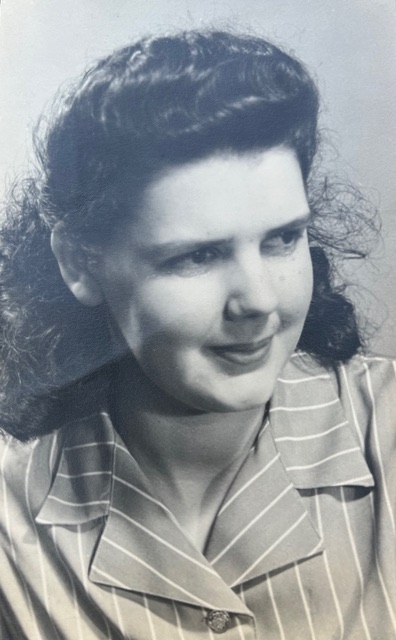
Cicely Young, née Wood, aged 21. She sent this photo home from England with “all my love” on 19 May 1944.
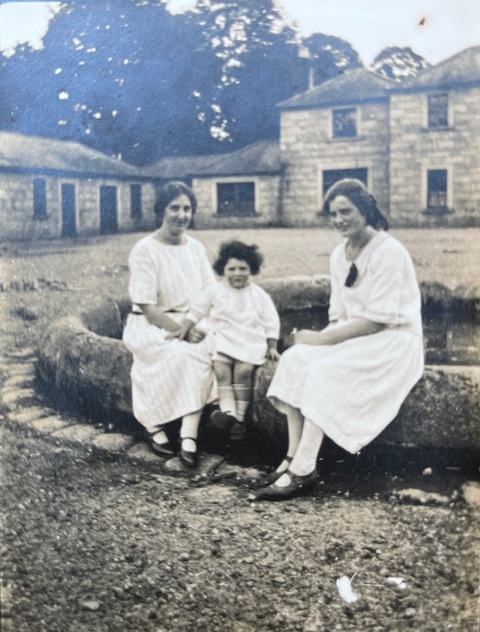
Susan with young Cicely and another unidentified lady in Lisnavagh farmyard, circa 1927.
Cicely Wood was educated at Disraeli School, Bough, near Rathvilly, where she met her lifelong friend Birdie Willis, daughter of Thomas Willis, the head gardener at Lisnavagh. She was confirmed in St Mary’s, Rathvilly, on 14 May 1937. She moved to England in about 1944, sending her parents a photo of herself in May of that year. She went on to marry Alan Young and moved up to Altrincham, Cheshire. She was the mother of three sons, including Philip Young and Andrew Young (born 1955, father of Kate Moyes), who I met in May 2026 when they came to visit Lisnavagh.
Cicely passed away aged 90 on 23 August 2013. Her funeral took place in the first week of September 2013 at St John’s Church in Altrincham, followed by a cremation. Her ashes were scattered at the church. (I have a note that they were scattered with her father’s, but we believe Walter was buried in Rathvilly so how can that be so!?)
Her granddaughter Kate Young wrote to us at the time of her passing. ‘I know my grandmother had very fond memories of the part of her life spent at Lisnavagh and was particularly proud to own a Lisnavagh chopping board which I purchased for her in Dublin. My family will certainly treasure the painting of the cottage at Lisnavagh for many years to come.”
With thanks to Kate Moyes, Niamh Shaw and Walter Wood.
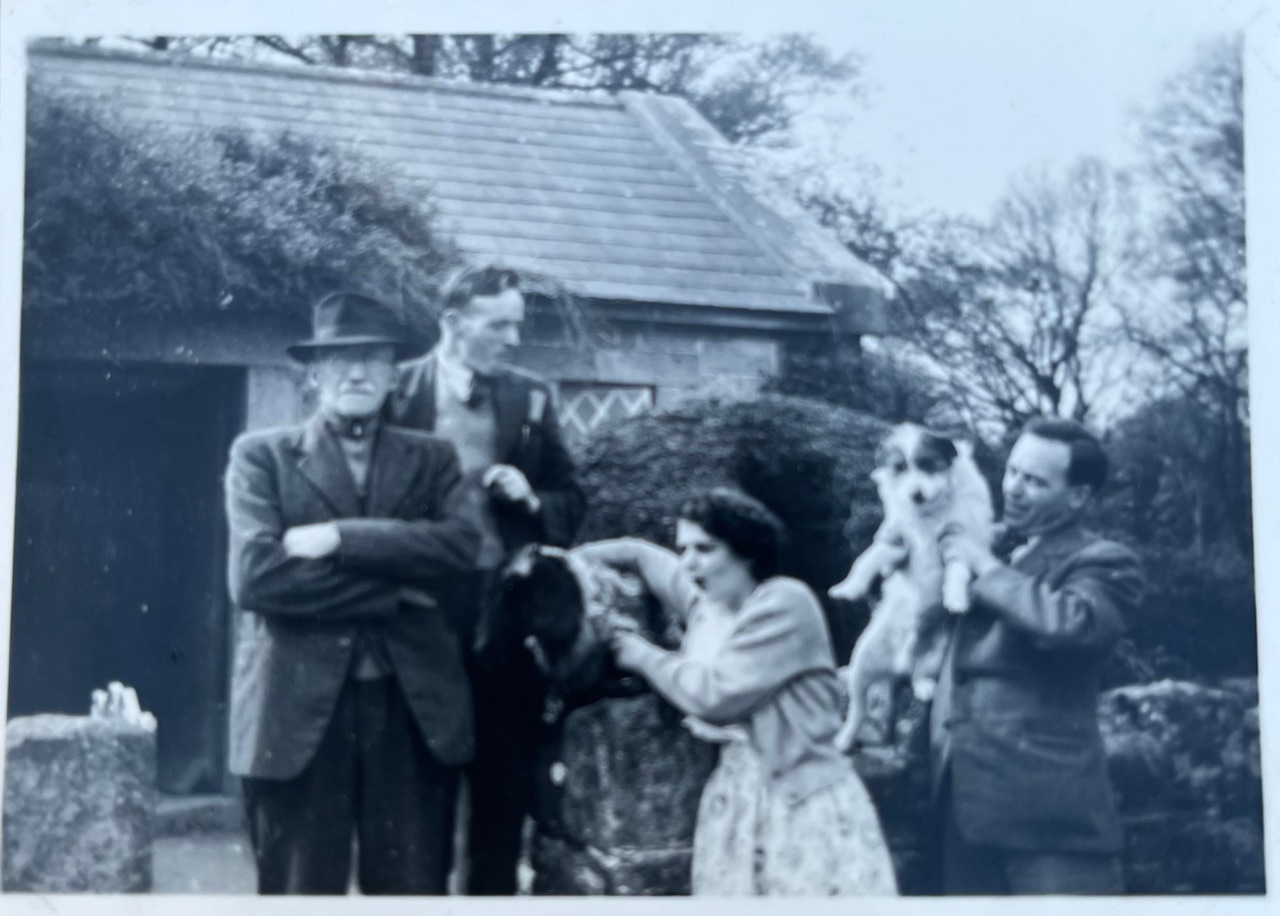
Cicely Wood with Tom Halligan, Paddy Halligan and Tom Halligan junior outside the Blacksmith’s Cottage at Lisnavagh. See here for more on the Halligan family.
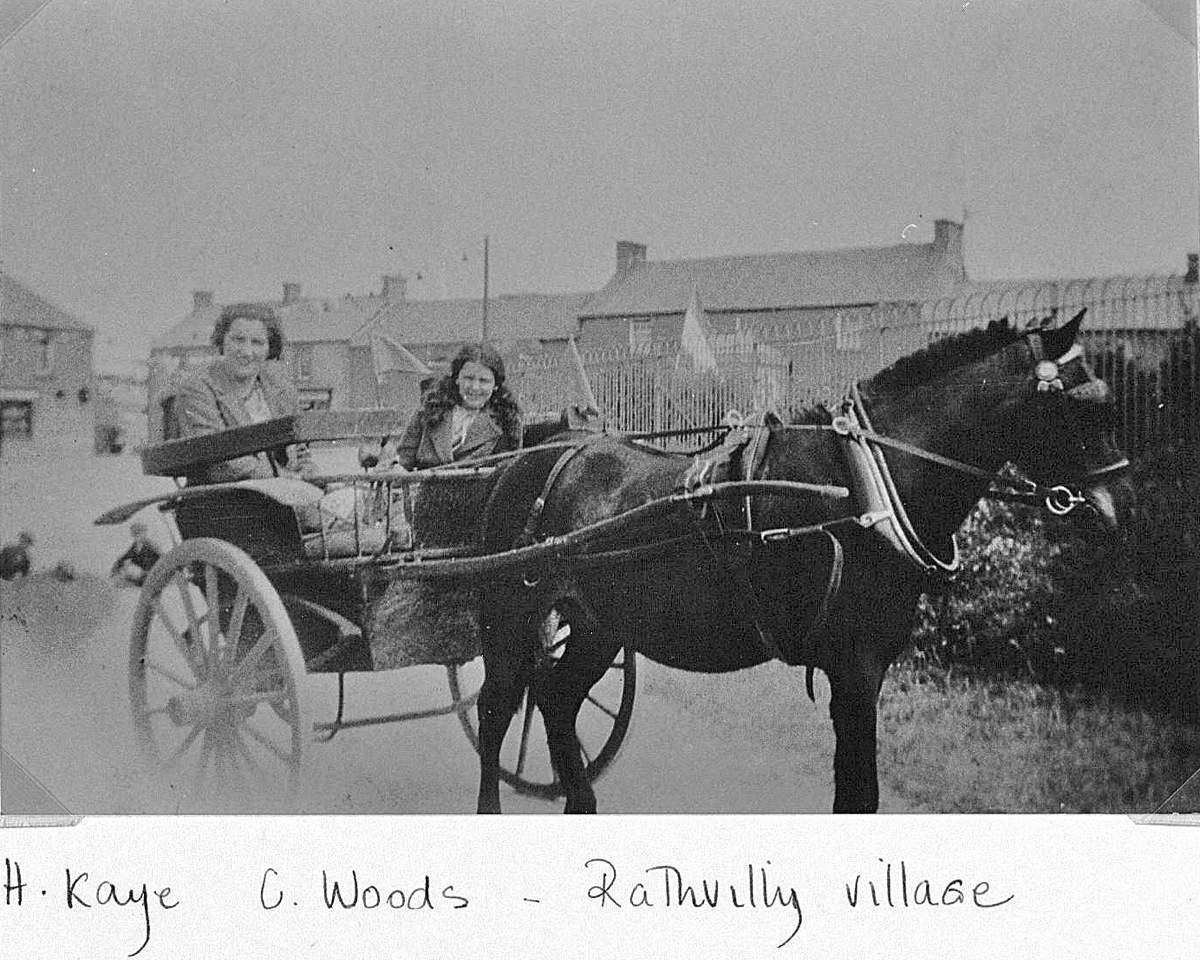
Hilda Kaye and Cicely Wood in Rathvilly, c. 1936
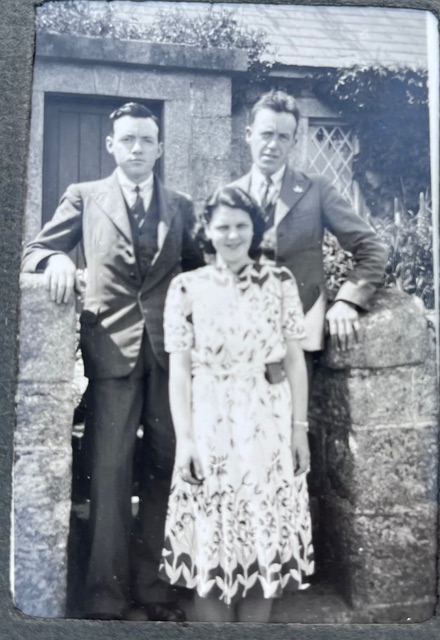
Cicely with, I think, two Halligans c. 1938-1942?
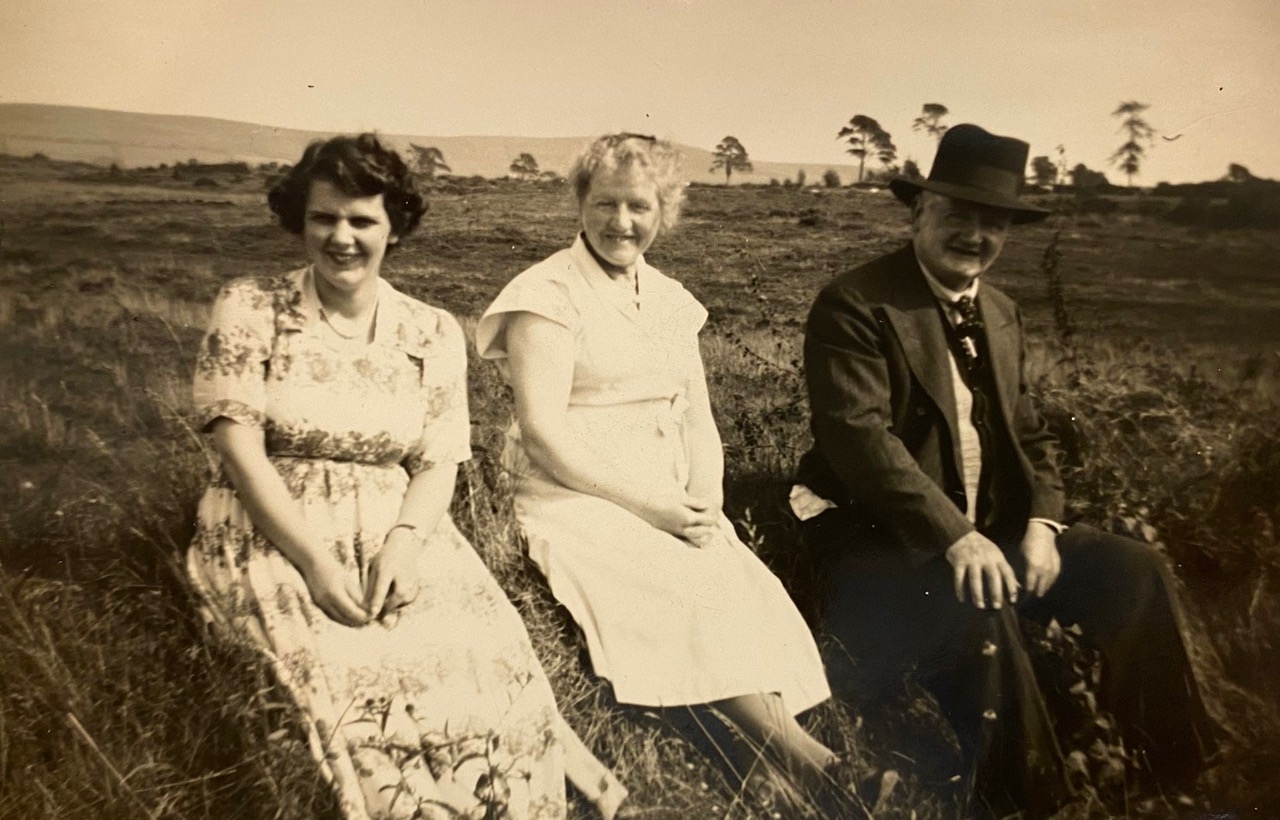
Walter, Susan and Cicely c. 1950.
End-Notes
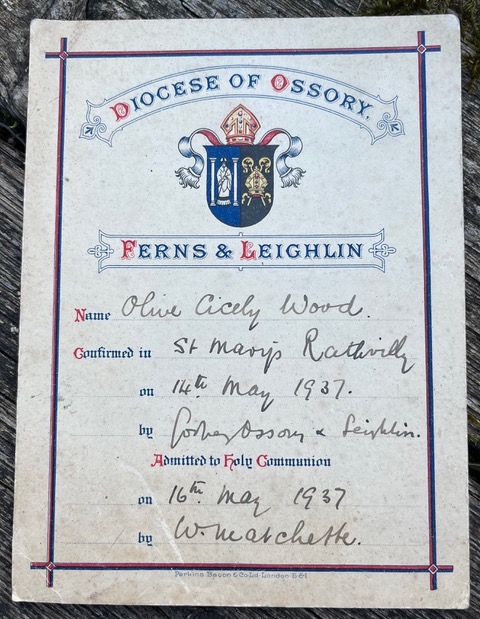
Cicely Wood’s confirmation, 1937
[1] Gilbert is known to have had siblings but it is not known how many.
[2] Kate Moyes advises that they have the baptism certificate in the family.
[3] See Ada’s census 1911 form here.
[4] Fuller details in Drogheda Argus and Leinster Journal, 1 July 1922, p. 3.
[5] Full particulars of sale are at Drogheda Advertiser – Saturday 27 September 1924, p. 4.
[6] Drogheda Advertiser – Saturday 21 April 1928, p. 4.
[7] Drogheda Advertiser – Saturday 21 April 1928, p. 4.
[8] Irish Independent – Saturday 04 October 1930, p. 6.
[9] Drogheda Independent – Friday 26 January 2001, p. 19.
[10] One possible fit I have found for her on the 1901 census is a 20-year-old Susan Campbell, here, working as a general servant in the home of her uncle Joseph Campbell, a Roman Catholic fisherman, at Derrylard, near Maghery, on the shore of Lough Neagh. However, that lady gives her religion as Roman Catholic.