See here for more stories of Ireland and the Great War
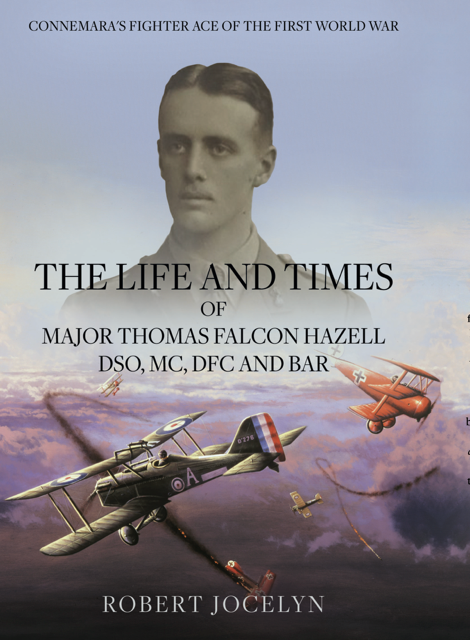
The Life and Times of Major Thomas Falcon Hazell, DSO, MC, DFC & Bar by Robert Jocelyn. The book was published with Troubador Publishers in the UK in 2026, with help from the Great War Aviation Society. The book is available from Amazon here.
Thomas Falcon Hazell was one of the Great War’s most formidable yet least remembered Irish airmen: a Connemara-born fighter ace credited with 43 victories, including ten observation balloons, and the most successful British or Irish ace to survive the conflict. Robert Jocelyn’s new biography restores Hazell to the wider story of Irish participation in the air war, while also following his remarkable post-war life in aviation, industry and the west of Ireland.
The Life and Times of Major Thomas Falcon Hazell, DSO, MC, DFC & Bar by Robert Jocelyn recovers the story of a man who belongs in the front rank of Ireland’s First World War air aces. Born on 7 August 1892 in the Roundstone–Cashel district of Connemara, Thomas Falcon Hazell belonged to a family embedded in the industrial development of the area. His forebears had established an alginate enterprise; his maternal grandfather, Captain Cecil Buckley, had received the Victoria Cross for his actions in the Crimean War. Hazell’s own life would unfold across the very different worlds of the Western Front, the post-war RAF, and independent Ireland.
Hazell was educated at Tonbridge School and, on the outbreak of war, enlisted in the South Irish Horse. He subsequently received a commission in the Royal Inniskilling Fusiliers, before transferring to the Royal Flying Corps. His flying training at Castle Bromwich was not without danger—he survived a serious crash—and he reached France in December 1916. There he entered the rapidly evolving and exceptionally lethal world of aerial combat. His career as a front-line fighter pilot would be brief, amounting to less than eighteen months of operational service, but its intensity was extraordinary.
Flying Nieuport scouts with No. 1 Squadron, Hazell claimed his first victory on 4 March 1917. By August he had secured 20 victories. He was a natural aggressor in the air: bold, technically assured, and apparently indifferent to personal danger. One contemporary described him as an “outstanding airfighter” but “very reckless”, observing that his middle name suited a pilot who struck “like a falcon diving on its prey”. His habit of wearing a fox’s brush on his flying helmet added to the image of an audacious and distinctive combatant.
Hazell returned to combat in June 1918 as commander of “A” Flight, No. 24 Squadron, flying the S.E.5a. This was the period that secured his place among the foremost Irish air aces. He made a speciality of attacking German observation balloons—large, flammable targets but heavily defended by anti-aircraft fire and fighter escorts. Ten of his 43 credited victories were balloons, a remarkable tally in a particularly dangerous category of air fighting. His final victory came on 4 October 1918. His overall score included eighteen enemy aircraft destroyed, fourteen driven down out of control, ten balloons destroyed and one captured aircraft, with several claims shared.
The episodes involving Ernst Udet and Hermann Göring give Hazell’s career a particular dramatic force. On 22 August 1918, during an attack on a balloon, he encountered fighters led by Udet, Germany’s second-ranking ace after Manfred von Richthofen. Udet’s aircraft riddled Hazell’s machine, striking the petrol tank, propeller and longerons; petrol filled Hazell’s eyes. Yet he fought his way home and landed safely. Udet believed he had destroyed his opponent and claimed the incident as a victory. Hazell also clashed with Göring, who later gave a characteristically self-serving account of the encounter. Jocelyn uses contemporary British and German records to place these episodes in their proper context, rather than merely repeating the legends that have accumulated around them.
Hazell’s decorations—DSO, Military Cross, Distinguished Flying Cross and Bar—reflect both the scale of his achievement and the consistency of his courage. His DSO citation commended “bold determination and rare courage”; by war’s end, he had become the fifth-highest scoring British ace and the third-highest scoring Irish-born ace, after Edward Mannock and George McElroy. Unlike Mannock and McElroy, however, Hazell survived the war. In the framework of Ireland’s air-war history, that fact gives his career special significance: he was not only among the leading Irish aces but also the foremost survivor of that exceptional cohort.
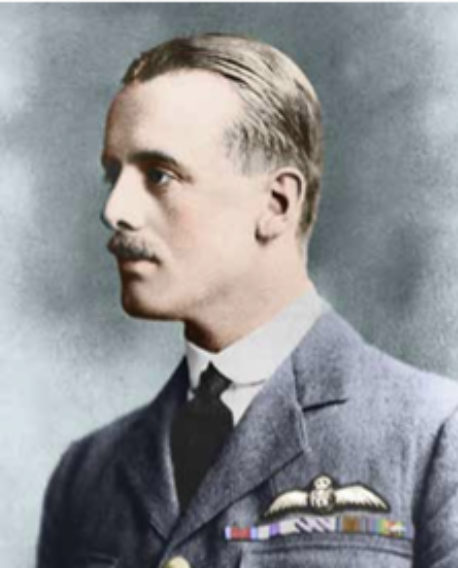
Major Thomas Falcon Hazell, 1926
Jocelyn’s biography is more than an aerial-combat narrative; it puts Hazell back into the social, familial and political landscape from which he came. The book explores Connemara, the Hazell family’s alginate business, the era of Marconi’s transatlantic station, and the shifting Irish context in which some 200,000 Irishmen served during the war. It also confronts the archival challenges of reconstructing a life where personal letters and diaries have largely vanished. Jocelyn has instead drawn on combat reports, squadron diaries, family material and patient research at The National Archives, Kew.
After 1918, Hazell accepted a permanent RAF commission, serving in Iraq and on the North-West Frontier before retiring in 1927. Back in Ireland, he became instrumental in the Irish Aluminium Company at Nenagh, a major industrial undertaking in the young State. His later association with Mary Barrett—who became the company’s managing director and his sole legatee—adds a final, human dimension to the story.
Hazell died at Newport, County Mayo, on 4 September 1946, aged 54. Jocelyn’s book ensures that this exceptional Galway airman, long overshadowed by more familiar names, returns to his rightful place in Irish history.