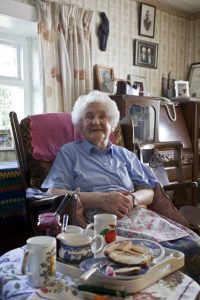
Cecil Samuel Gordon Falloon — universally known as Paddy — was one of Northern Ireland’s best-known businessmen, hoteliers and restorers of historic buildings. Born on 10 July 1911 at Camly Macullagh, near Newtownhamilton in south Armagh, he was the youngest of four children in a Church of Ireland farming family. Educated in England, he was in business by nineteen, running one of the first all-night petrol stations in the country, on the Oxford road near Witney. Returning to Ireland, he took over the seventeenth-century Old Inn at Crawfordsburn, County Down, and, after wartime service in Stormont’s Home Affairs department and two post-war years in South Africa, farmed Kerry cattle at Kildalkey, Co. Meath. In 1956 he bought a bankrupt brickworks at Toomebridge on Lough Neagh and built it into a major operation; a year later he acquired the village of Dunadry with twenty cottages and a derelict paper mill for £2,500, opening the celebrated Dunadry Hotel there in 1966.
With Brum Henderson and William MacQuitty he co-founded Ulster Television, sitting on the board from 1959 to 1981 and appearing on early chat shows with liberal, iconoclastic views unusual in 1960s Ulster. Paddy was married three times – Yvonne Calvert (1941), Helen Owles (1947) and Jane Chichester-Clark, née Goddard) (1977), formerly wife to Sir Robin Chichester-Clark (1928-2016), the last MP representing a seat in Northern Ireland to be a British government minister. A founder of the Ulster Architectural Heritage Society (1967), Paddy restored fire-damaged Millicent House, Co. Kildare, from 1975. Charming, opinionated and a lifelong friend of Seamus Heaney, he retired to Oxfordshire in 1999 and died in England on 21 March 2003.
The following memoir was assembled by Rosa Kenda in 2001.
Introduction
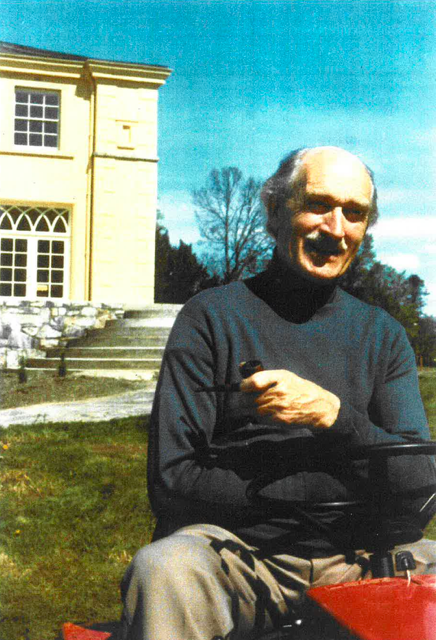 Having spent three years studying, I had just finished my degree in the University of Maynooth and was feeling a little let down when I happened to sit next to Paddy Falloon at dinner in a neighbour’s house. He spoke about his life in a fairly desultory fashion whilst I spoke about missing my academic studies. We had been friends for many years, and it had always been a great privilege to listen to those oft- told tales. Paddy is a raconteur par excellence. Amusing stories elegantly told make him a wonderful dinner companion. This, together with his years of experience, his highly successful business ability, his good looks and that rakish habit he has of always bending towards the lady on his left make for some of the reasons why this man is dearly loved in Co. Kildare. Even at 87 he is upright and tall, a man who has not stooped under hardship nor has he failed to speak out against hypocrisy. We decided to pool our resources to try and make a small book for his family of his life.
We got together with a recording machine for the first time in 1996, on 12th April. Millicent was still his house at that time. It is an historical house, which was built in the eighteenth century, wrecked by fire in the 1960’s, and rebuilt to its present glory by Paddy. It is situated overlooking the Liffey on a rise, which suggests ancient fortifications on either side of the river.
It was at Millicent that we grew to know the Falloons. On arrival, its clean lines and wide steps welcomed the visitor with grandeur. An avenue between trees led to the entrance. One stood on the steps, looking back at fields of corn swaying in the wind, fronted by young poplars. Despite the fact that the house no longer has any land there is no other building within sight, and the neighbouring farmer usually ploughed.
Jane and Paddy filled their house with friends from near and afar, their invitations treasured and accepted by all. Arriving in the drawing room, a long room with tall windows, one was drawn to the vista of the River Liffey, gracefully adorned with swans, floating, white on the black river. One always had the impression that the Falloons entertained as a gesture to their lovely house. They had every size of dinner party, from just a couple to over a hundred. No matter how big or small the numbers, the house adapted. In the basement there was a hall that was used for concerts, fairs, plays, all given in aid of the church or some other charity. They even had some weddings there. One of the Weld sisters, I think it was Gay, had her wedding celebration in the basement. Their being in Kildare brought joy to many, not only in Ireland but from as far away as America, Australia, and South Africa. Arriving one was greeted with a great welcome, making every guest feel special. It was a house with open arms, a very Irish house full of hospitality. It was a house happy in its owners.
It took several sessions with a tape recorder and several glasses of wine to bring together this little book. Paddy and I enjoyed doing it and hope that it will give pleasure to his children and the coming generations.
Rosa Kende, 22nd February 2001
The Beginning
I was born on July 10th 1911, the last of four children (a little boy followed four years later, but died at birth), of Samuel and Esther Ann Falloon in that rugged area of poor land on the borders of Louth and Armagh. Slieve Gullion and the Forkhill Mountains dominate the landscape. Falloons – the old name, in Irish, was O Fallamhain – farmed there for four or five generations. We came up from County, having been chased out of County Meath by the Elizabethans at the latter end of the sixteenth century. The area in Meath of the old clan lands around Athboy and Kildalkey, is still called Baile Falloon.
We claim our ancestor was one Edward O Fallamhain, who was given permission by Queen Elizabeth to build a stone house on the Roscommon side of the Shannon at Athlone. He was also granted the rent of St. Peter’s Abbey, and four stone cottages, at a cost of 4 pence for a year. Apart from that, little is known, but we can guess the hazards of the Cromwell invasion, the Williamite wars, and the scattering of ancient Irish families. Anyway we have survived, and are still in the land of our forefathers, even if not in the best lands. The clan has produced poets and writers, lawyers, one very famous ancestor was James O’Fallon, an officer in the American War of Independence. His son, Colonel John Fallon also served along with another son Benjamin Fallon, who was known as “Father of the Tribes” for his work and success in establishing friendly relations with the Indians. We also produced a couple of Medieval bishops.
There was a related family of Falloons in England. One Canon Falloon of Longford who wrote a book – Foundation Truths – and his son, the Rev. Hugh Falloon of Clifton, Bristol. It was this Hugh whose daughters ran a boarding school at Dover. Another of this line was Hugh Cecil Falloon – a banker in Hong Kong. He was thought of as the rare member of the clan who was “in the money”.
On a lighter and happier side it was written,
“The O Fallamhains, who marched with free
born chiefs of Clan Iladach, of wine banquets.
Men who let not their spears decay
Of those are the free born clans”
My father was a big man in every way. He was 6’4″, slender and upright and very much in the character of an old Gaelic chief. He liked to play the fiddle, which he held against his breast, rather than under his chin. He liked to talk of the great days of old Celtic Ireland and used to admonish my brother Jack and me, to try always to forgive being driven from the good land of Meath – “but never forget it – you were immersed in the peasantry for four hundred years to teach you humility.” He used to say “one good boast a day will do you no harm – but leave it at that.”
My father’s family was an old Irish family. The son of Eochaidh Muighmheadhoin was christened O Fallamhain in A. D.358. There we started. O Fallamhain means Head or Governor, a title given to the eldest son of the King. His descendant was my father, that is, of the same clan. I think that it was his grandfather, or his great- grandfather that was given permission to rent land in South Armagh.
He was a good farmer, careful and thorough, and had a special love of flax growing. He was a great sower of flax seed. He used put a kind of white sheet around his shoulders that formed a bag. He would dip his hand into the bag as he walked. That is how flax was sown. You had to take very regular steps, and to know what you were doing. My father knew exactly how to walk in a straight line up the field, and how to take the right width each time. It was quite a skilled operation. He used to sow for his neighbours, without charge. For him it was an honour to do it for others. The seed came from Russia. The linen business in the North of Ireland is still going. Linen has not been superseded but rather, it has been succeeded by artificial fibres made by great people such as Courtaulds who finally mixed them with linen. Unfortunately it creased. I could only wear a linen shirt once, (I preferred to wear a shirt twice), although a very particular wife would insist on a daily change! When rail became the big mode of transport, all the carriages had antimacassars on the backs of their seats to avoid staining from the Macassar oil men wore on their hair. This was a great trade, especially in America, as were linen handkerchiefs. Linen handkerchiefs were always worn, never cotton.
The relationship of my brother Jack and myself to my father was very normal; we never dared to be rude or to contradict him — we had great respect for him. We stood up when he came into the room, if we happened to be sitting — that was normal behaviour. Manners in Ireland in those days were like that. That was a hell ofa long time ago. Children were taught to be good-mannered to their parents — you would not allow your mother to open a door; when she got up to open it, you would go and open it for her. When your father came into the room you would stand up — nobody does that now, it is all forgotten, but it was not unusual in my day. It was the norm, very much the norm.
I had a perfectly happy relationship with my father. When I first got an air gun, I used to practise shooting with it, and sometimes out of that mischievousness which is in us, I suppose, I might take a shot at a hen, out in the yard; not to kill it, but to make it jump — and I would be punished for that. He did actually see me doing it once, he undid his leather belt, and said — “Now — if ever I see you doing that again you’ll get a touch of this belt where it’s going to hurt — across your backside”… So I made sure that he never saw me doing it again, and I probably never did it again. I never remember him beating me — J remember him threatening to give me a good smack if I’d done something wrong, but that is all. One was brought up in a very quiet civilized way, you know. It was quite different from today — and it was different because we were in the country – we were away from the nearest town —two and a half miles away — and it wasn’t a town really, it was a village.
My father gave up Church and all it entailed long before I knew him— in fact he could not bear the thought of it. He used to say of Religion, “Why is it not designed to keep people together in the love of God and in the warmth of friendship towards one another instead of creating this divide (between Catholic and Protestant.)?” The divide was terrifying — Catholics kept themselves so far apart that you had little in common with them. If you talked about sin, that, in itself, was a sin. There were few Protestants in the area. The Craigs and the Bradshaws — they were farmers and people of some education. The Catholics had little or none. In fact there were only two Protestant families in the whole of that area. My father never really spoke about his youth. He was brought up on the farm.
He talked about his mother quite a lot.
His mother was a McLean – a farmer’s daughter. The McLeans were “strong” farmers and my grandmother owned property in the town of Newtownhamilton. She lived well and liked her gin. She reared 10 children of whom all but four died of T. B., that terrible killer. Two of the boys, aged I think about 17 and 21, left for Australia — to escape the “decline”, but died in Sydney a very few years later. That dear old Granny ran a soup kitchen in 1845-48 to help the more needy. I have two of the old delft porridge bowls she used at that time. She was a pretty dominant creature. She wasn’t over rich — she was comparatively well off.. There was a lot of poverty in Newtownhamilton, which is in the very south of Armagh. She was the daughter of a fairly well-off farmer and a wonderful old lady. I only just remember her. I used to be brought up to her room. She lived in a different house. My Uncle David lived in the old house until he died, and then we moved into it. Prior to that, before my father married he built a house, in fact he extended an old one, on the same farm. Only two of that family survived – my uncle David and my father. They lived on the farm and worked it together.
My mother and her brother ran the local school near where I was born. She was a Purdy from Annalong, County Down. They were Huguenot originally; they came across when the French chased the Huguenots and the Protestants out of France and they settled in Scotland. I do not know anything about that period in Scotland but it would have been in her great-great grandfather’s time that they came over to Ireland and settled in Annalong. They owned two ships, and they earned their living by plying their trade between England and Ireland. One of those schooners was called Volant — my mother’s family had this boat right up to the last war, when it was taken over by the British Navy. The Navy used it for spying out German submarines. It ended its days doing just that.
Trinity was the Purdy’s place, and there were quite a number of them, at the one time, of the same family. There were two or three doctors, and a couple of clergymen in the Church of Ireland. The rest of my mother’s family were teachers. She drilled us in the three Rs and she was definite about her trinity of priorities. The Teacher, The Doctor, and The Nurse, – those were people who mattered in the human race.
I’m sure she would have included the Farmer, but that would have demeaned the sanctity of the trinity. She didn’t mention lawyers or clergymen, although she had both in her family.
My mother used to write letters for neighbours who needed to communicate with relations who had gone away. They would stand as she wrote, the letters were immensely formal, giving in stark sentences the news of people who had left, or the birth of a new baby. It was important also to acquaint the family of the death of any who had remained in Ireland. You could say that nearly all the people who came to have their letters written were Catholic, the Protestants were better educated and were able to write themselves. She was a wonderful, wonderful woman.
Anyway I had my first schooling at her school.
Brother Jack stayed on the farm, and worked with my father — he was a top class farmer. My father was a perfectionist and Jack had to be damn good because he would have been told off if he wasn’t!
During the wag my brother worked as a temporary officer in the Ministry of Agriculture, endeavouring to find working girls to help on farms There was a rather amusing story about that. One old farmer rang him sometime afterwards and said, “Tell me this, Mr. Falloon, what are we supposed to do with these girls in the daytime?” That was just the funny side of it. I think he did good work — he threw himself into the job, helping all sections, not only the girls but the Ministry and the farmers too. They were all very nice girls. That was his wartime work, but normally he was a farmer — with an open lovely character.
I remember once when I had great trouble with one of the staff at Crawfordsburn, in the Inn and Country Club. She had been with me for some years when she married one of my employees. I lent her a cottage free of rent, free of everything for the time being. After some time I had to take the cottage back, because my darling mother was in very poor health. I decided that the cottage would be ideal for her — I had already engaged a nurse for her and her doctor was not only a great friend of mine but also the local doctor. (In the event it was a wise decision since she recovered.) I had to ask Josephine to leave the cottage. I gave her plenty of notice but she refused to go. She caused trouble and would not even accept another cottage that was nearer to the village. JI remember passing her on the little street in Crawfordsburn when walking with my brother Jack — she turned her face away as we passed, and almost spat as I passed; I said “My God!”. “Ah”, said Jack, “Just pretend she has done nothing wrong: forget it. You’re very lucky that you haven’t got a nature like hers.” That was the sort of fellow he was. He was a more generous and a more lovable character than I am sure I was. He probably was not up against all the worldly things that I had to contend with, but, even if he had been, he would have applied the attitude to life that was his; a very serious, a lovely Christian attitude. He was very forgiving.
He was a countryman. He did not like towns. He married a very nice girl, Daphne and they had three daughters: Rosemary, Maureen and Heather. They all trained as nurses, and two of them run their own nursing homes in the North of Ireland. One each married a man who owns and runs Dobbins Inn in Carrickfergus. They each have two children: a son and daughter.
Jack died when he was 89, and was buried in Newcastle Co. Down where his wife came from. He was eight years older than me.
My two sisters went to England early, one married an ex-soldier in Buckinghamshire and it was by him that she had the children. He was a very nice fellow, with an interesting war career, but he is dead now, and of course she is dead.
My other sister, my elder sister, Gladys, went down to somewhere in the middle of Ireland, when she was young, to a relation of my mothers, who was not only the local rector, but also the head master of the school. She taught the juniors. She did that for a long time. While Gladys was there, a lady came to visit. She was French and a great milliner, and she had a very upper class shop in the Bond Street of Liverpool. Gladys was so intrigued by her that she went over to England with her and trained with her in millinery. That was how she began. Afterwards she started her own millinery shop in Brackley in Northamptonshire. Subsequently she moved to High Wycombe where she made hats for people who went to Henley Regatta. She became quite famous. I have a whole lot of newspaper articles about her. She had two daughters, Sheila and Elaine. These two girls went to Wycombe Abbey for their schooling and the older of the two was the first pupil to get married there. Sheila Bedford married Francis Ferris who is now a High Court Judge. Elaine married a solicitor called Tony Reid.
Freda married three times. Her first husband’s name was Meanwell. She had three children, John, Kathleen and Patricia. John is in Australia, Kathleen is married to a High Court Judge called Michael Wright — Patricia is married to Andrew Dodwell. Kathleen Wright is a JP. Freda, after her husband died, lived alone in a house near the river Thames outside Henley. Dear Freda is dead and gone now and the house was sold. Michael Wright and Francis Ferris cannot come over to Ireland because we were shooting judges, and the police restricted their travel. I see them nearly every time I go to England, and in fact we stayed with one of them the last time we went over.
Early Years
Later I went to the Model school “Newtown Hamilton”. This was to be more advanced and it was blessed, in my time, with two great masters – Master Donaldson and Master Loney. I may have disappointed my parents in showing no signs of ever wanting to be a doctor, so I was sent to England where I had two uncles who were Church of England parsons, one connected with Durham Cathedral and one in a parish in Yorkshire. I was to be trained for Oxford and the Church. I missed both, but I have learned to carry the two chips – one on either shoulder. Sometimes I do waver towards regret when I imagine how exciting it would have been to be the Bishop of Clonfert in Co. Galway. The wonderful Romanesque Church dating from the 10th century- it has a superb Chancel Arch at the east end with a beautiful mermaid inset, which now, after all those centuries has the best hand-polished breasts in Ireland. I have no idea of its significance, but these mermaids are very rare. You see them in old churches in France, and there are one or two in Oxford on the outside, but this is inside, and both breasts are big. They are polished like marble.
Everyone who comes in looks at them, and says “how wonderful”, and rubs them! It is possible, if I had gone on with the Church, that I might have been Bishop of Clonfert!! I could have rubbed the mermaid every day. Sometimes I do waver towards regret when I imagine how exciting it would have been to be about the Chancel Arch or the mermaid in those far off days. What I really wanted to do was to fly an aeroplane and I had a big thought about joining the Air Force. That thought too came to naught. Maybe it wasn’t strong enough.
Anyway, for whatever forgotten reason, I joined, as an apprentice, an old London firm of wool brokers, and woolen material exportation. It was in the City and dealt in the finest English homespun, gabardines, flannels, saxonies and worsteds. It was exciting to be in London and to be connected with material that was the best in the world. During that period I would come back to Ireland on the Liverpool-Belfast boat, travelling third class and steerage. A two-birth cabin could be had for 2s6d per berth; the whole cabin for 5s, and the fare was £1. Total £1.5.0. On one of these trips I met a man who was to become one of the closest and best friends I have ever had. His name was Douglas Boyd. He was a young doctor who had just started practice in Belfast.
It was at that time, and of course before that time, that I was always sketching and drawing and imagining houses that I would build. Seeing all those beautiful English Inns, I thought what a pity it was that we did not have any in Ireland. The conversation in the pubs of Ireland would be better, I thought, yet we did not have the atmosphere. I made the 25/- trips as often as my £6 per week wage allowed.
All my life I have had a love, a great love for classical music and a dreaming love of beautiful buildings. As a small boy I used to design a great entrance and have a stairway to the old whitewashed farmhouse. But it was England that nourished that love. When! got to know a bit more of the English countryside, (my sister Gladys was married and living in Northamptonshire), and when I saw and drank beer in lovely old English Inns, I used to think how wonderful it would be to create something like them in Ireland. In Ireland there wasn’t anything like the old English country Inn. Here we had the “spirit grocer” and in towns there was “Mc Kenna’s Bar”, but they had no warm “come hither” atmosphere like the “Royal Oak” or the “King’s Head”, and of course there was no garden and no pewter pots of beer.
Even in London, among the piles of super worsted and soft west country Saxonies, my mind would often, maybe too often, turn to the thought of creating in Ireland a real Inn that would be to Ireland what the English Inn is to England. It would have to have, must have, Irish characteristics but my dream was born in the old English Inn.
A trip to Witney and, near it, “The Rose Revived” could have been the trigger for the shot, but it was one that I did not fire for a few years.
I was the owner at that time of a wonderful little three-wheel motor made by B. S. A. Birmingham, probably to compete with the well-known “Morgan”. It had a four- cylinder engine, a fabric covered body, with a front two-wheel drive. It was smart, quite swift, and comfortable and very cheap for me as my dear sister paid for it. So many things are always there to be noticed if one has that noticing nature – which, of course, can be irritating to one’s friends. Anyway my “noticing” nature led me to be irritated and amazed that there was a great, a total absence of petrol stations (open day and night) between London and Witney and beyond. I decided to make a survey.
Here was something that needed attention. I left London and the soft wool.
Selling Petrol in Witney
I set off at nights in my little three-wheeler, with coffee and sandwiches from my sister’s house, (by then she had moved to High Wycombe) to check and count the volume of traffic on the main roads out of London. Very soon I was convinced of the need for day and night petrol stations on all the main roads. Anyway the long and short and, indeed, the long and long of this early survey, (it was, I think, around 1930), was that I decided that somewhere near Oxford would be the ideal place.
I found it just west of Witney where two big transport sheds (part of the 1914-18 war RAF Station) were situated on the edge of the road. I made a deal with the owner, a charming old gentleman builder in Witney, to lease me the sheds with an option to purchase later. I opened the first day and night petrol station on the main road – London to Wales – National Benzol mixture, Shell and R. O. P. – Russian Oil Products. I remember that R. O. P. was the cheapest at 11d a gallon. I had to make my own electric light – so I bought an old diesel engine – one started with a blow lamp – it was called a hot bulb – very advanced for that time.
I discovered some old light fittings in the shed (ex RAF surplus) so I had 4 Poles on the gable ends and lights at the top, which blazed away at night. One could see the place for miles east and west. I called it ‘The Blarney’ and painted it all white and green. Very soon there was a demand for food (snacks) as well as petrol and oil. And so, a snack bar was arranged and hot English Pork Pies – coffee, cigarettes and tobacco were supplied. The attendants were fine old ex-Royal Navy men.
I made myself quite a comfortable flat in one of the sheds where I had a good bed and a big basket for my half Alsatian/half great Dane dog, Lulu. Life was interesting, very, and fun. It was still the days of great cars – Speed Six Bentley and “98” Vauxhall, and 25″ Alvis. I had advanced from a 3 wheeler to an Alvis and later to a Lea Francis – these were big money, like £70 and £90, We never asked callers how many gallons? It was always “fill her up, Sir?” and “may we check your oil and water”. We always had a chamoix and cleaned the windscreen and the lamps fore and aft. So much more advanced than 1990 when they are still calling them Service Stations, but there is no service. Now you have to do it all yourself and then walk to the office and pay the comfortably seated attendant.
These are the days, or are they?
I had a lovely girl friend – soft and cuddly as a Witney blanket. It was she who first took me to the “Rose Revived”. We would take a picnic and a HMV portable record player, Schubert, Chopin and Mozart records, hire a boat and go on the river. I thought that England (that part of it) was heaven – so it was. The old “Rose” had a semicellar with stone floor and great beer casks – your beer was drawn from the wood. What character, what memorable simplicity. Now it’s all tarted up – carpets, chenille curtains, polished tables and, I am sure, no smoking signs and television. Why do we do it, and for whom? During that time I saw a lot of Oxford, and I made a number of friends there, and often regretted never having been able to “sport my oak” or sing on Magdalen Tower. But, as they would say in Ireland, “sure you might have fallen off and killed yourselft” I sold the station to a lovely man and a great engineer. The Hon. Doris Mason bought it for him. She was very fond of Jack. I remember her well, tall and very attractive. I thought that they would probably get married. They never did, and I do not know what happened to her. Jack Warton was one of William Morris’s (late Lord Nuffield) top men and had great training as a result in his field of engineering. The famous Morris cars were stamped with his genius. He was an outstanding Englishman in the great days of England.. During the 2™! World War he tumed the sheds, and they were big, into a fine engineering works to make parts for the Navy and the RAF. He was also a great steam man and developed the hobby extensively, repairing and exhibiting all manner of steam traction engines. I called to see him only a few years ago. He had retired, and we talked of old times. J was so pleased to see him for, only a short time after, he died. He was given a great funeral in Witney. His coffin was drawn by one of his steam engines, and the Times devoted almost a full page to wonderful dear Jack.
At this time I was, I think, 24, so, back to Ireland. No thoughts then of petrol stations, but serious elated thoughts of an Irish Inn – it just had to be.
Crawfordsburn
I returned to Ireland after my unusual education in England. I stayed with my friend Dr. Douglas Boyd, who had a house in Belfast. No. 3 Queens Elms, now part of Queens University. Almost by chance, (or was it?), on the way to Bangor, I stopped to look over the village of Crawfordsburn. There was an old thatched Inn – Crawfordsburn Inn – said to date back to 1614. It had been a well-used stopping place for the horse drawn coaches taking passengers from Belfast to the Cross/channel boat that sailed from Donaghdee to Portpatrick in Scotland. The owner, Mr. Johnston, who still lived there, had lost the licence through some quirk. He owned restaurants in Belfast, and apparently he was accused, maybe wrongly, of having a semi daylight brothel in these restaurants He fell out with the police and so on. When it came to the renewal of his licence he was such a decent old buck, he never thought, and did not get advice, that he should have had the licence put into his wife’s hame.
Of course he lost the licence. He was thrown into a bitterness about this, and that is why I got it, why I got the lease. He had built a ballroom and tea dance hall further down the village — He called it “Cingalee” after some show in London. It too was almost closed.
I was very excited by both places. The Inn garden was on the edge of the Glen, a wonderful wooded area that went down to the sea (Belfast Lough) near Helen’s Bay. The whole place was idyllic – it spoke of Haydn and Mozart – unspoiled and peaceful. Money. I had none or nearly none to bless the schemes that were racing through my head. I got the bank to help mea bit. Anyway, J did a deal with Mr. Johnston. I leased the Inn and the Cingalee at a very modest rent with an option to purchase the freehold at a specified figure, which I thought reasonable. My mother gave me £500 and my sister £500, and this, with the result of my sale of the Witney Petrol Station, was enough to give a great blast to the fire in my head. Now the first job was to get the licence restored to the old Inn.
My solicitor was Sir Dawson Bates in Belfast, and he arranged the application. Of course I couldn’t get it because the North was full of members of the Presbyterian Church. The case came up before the County Court judge in Newtownards (the judge was an uncle of Sir Dawson Bates), and although my lawyer, G. B. Hanna K. C. put up a great good case to have the old Inn licence restored and gave a glowing account of me and my ambition to make it the best Inn in Ireland, the judge (a very fervent teetotaler) turned it down. He was determined to reduce and indeed stop drinking in Ulster and, he hoped, all Ireland. How selfish the righteous are. Well, as they say here, it shook me, but the flame still burned.
There was no “Country Club” in Ulster. I mean no real “fun” Country Club. Here was an opening, a vision. I’ll give them fun and games, if I am not allowed to give them an Inn. Money was getting short, but I persevered. I pressed on but not regardless. I built a great badminton hall and a squash court and four superb tennis courts with green tops after the style of Mussolini’s green courts in Rome that were much lauded then. Over here they were all dusty, red-topped en tout cas. A friend (one of the North’s great linen Barons) came in and provided more finance. We hada magnificent ballroom, and we had tea dances on Wednesday and Saturday afternoons and big dress dances on Saturday evening. Drinks were easy – you brought your own.
I brought over a well-known 17 piece band (Tony Linnell) from Leicester. They were outstanding, and the BBC decided to broadcast our dance music most Saturday evenings. It was real dance music then, in line, or nearly, with the Jack Hyltons and The Savoy Orphans. There were no electric punk decibels in those days! I built a little hut beside the dance hall where the BBC used keep all their instruments.
The first time it happened, the first broadcast, I remember going down to the old cottage that was in front. It was all very charming, very attractive, and I had the wireless turned on, and I was listening to the fellow announce “We are now taking you over to the Chalet Club in Crawfordsburn for an hour’s dancing, by the Chalet Club Orchestra, directed by Tony Linnell” That was the first in Ireland – my eyes were full of tears, the first time it happened, I was so thrilled, and we did it constantly.
That most charming and wonderful Lady Londonderry did us the great honour of declaring Ulster’s first country club open – it was all a great success. After 50 years it is still going strong, – I was invited to its 50th anniversary about three years ago.
Since I was the first member they had the good manners to invite me to plant a tree.
They now have about 1,100 members.
I tried again for the Inn licence, but again I was turned down on the score that I only “wanted the Inn licence so that I could feed the club with drink”. That was another big blow – but…
When I had applied before at the County Court in Newtownards, it was before Judge Bates, an uncle of Sir Dawson Bates, who was the Minister for Home Affairs, and my solicitor as well. When the case came up I had George B. Hanna a very famous K. C.. I thought that I would find out what sort of local people would be against it. There wouldn’t have been many in the village of course, there were very few people there, but, I thought, the local Presbyterian Minister would be a likely objector. I can’t remember his name now, but at that time I knew him very well. He said to me one evening, when he came over- we were having coffee or something else together — “Oh, Mr. Falloon I know your licence is coming up. I am afraid I will have to oppose it, it is a matter of principle.”
I said ” Oh well, I expected that. I didn’t expect that the Presbyterian Minister would be in favour. You could of course do nothing, at least not go against it. Yet it interests me when you said on principle, because the old lady, years ago, who owned Crawfordsburn, a Miss Campbell I think she was then, when she died she gave money which was invested to give over £200 a year to your Church. I would have thought that, on principle you might have refused this sum, since that had been earned in an inn.”
The other important man in the area was Mr. Stewart, – I cannot remember his first name. He was a big builder, but an educated fellow. He was also connected with the Unionists, some part, a branch of one of the Unionists, so he was in politics as well in the area.
He was the man who built the Four Courts, and he was the man who built Stormont, the parliamentary building, both magnificent and really enormous buildings. He had rented Crawfordsburn House, which was what the village was called after and which was at the end of the glen in the Bay of Helen’s Bay, a beautiful place. It was a really marvellous house even though it was not quite my taste in architecture; early to mid Victorian, classical, and beautifully done with wonderful gardens. It looked out to sea, and when the old Col. Sharwood Crawford’s estate was being wound up Stewart rented the house. Because it was important, I went down to see Mr. Stewart.
His butler showed me in, and he said “Sit down, sit down, Mr. Falloon,” I sat down and I told him that I had come to see him because I knew his name mattered very much in the area. If he were against it I knew it would be difficult. I had seen him before, and J had told him that I wanted to create a really lovely Inn, that would be to Ireland what the English Inn is to England. It would be quite different from anything we had. It wasn’t just a pub.
Well”, he said, “I will have to tell you now, Mr. Falloon, that Iam going to oppose your licence.” I said “Well, oh dear, that’s very shaky.”
“Well, ” he said, “I have a thing about drink. I am against it, and I don’t want to see any more pubs, Inns, or whatever you may call them. I am against it. It is just one of those things. My principles are totally against it.”
And I said “I am very sorry to hear that because that does shake me, apart from your standing within the district and the area, but you mentioned the question of principle. You see, I just read recently in the paper that you have accepted a contract to build a distillery in Scotland at a cost of £7,000,000. Surely there is some conflict there, is there not?”
He didn’t say “Go!” he just got up and I said “thank you very much for your time”.
But the sequel to that is something that is worth recording Years after that, after I had rebuilt the Inn and it was going, and going very well, I had just rebuilt a wonderful old ruin at the end of the village on the river, near a waterfall. It was an old mill, an old corn mill, and I lived there. It was a wonderful job, redoing it, – my heart was in it. One day, when I was working in the garden of the Inn, one of the staff came down.
“Mr. Falloon, there is a gentleman here to see you.”
And I came up from the garden and I met him on the balcony of the terrace, and here was Mr. Stewart. I said “Mr. Stewart, it is very nice to see you”, and he said “Well, I thought I would call and see you because J think you have made a wonderful job of that old mill.”
And I thought, this coming from a man of his experience “I think you have made a wonderful job of it, and the Inn is very attractive, you know, you’ve done it very well, and I just wanted to point out to you, that if you see any other place that interests you, and you want to go ahead with it, and you might be a little short of capital, don’t hesitate to come and see me, I’d be delighted to help you.”
I thought, Ohhh-wasn’t that wonderful!
The Inn was really my first love, so I was not overcome – but I was resentful. I got wonderful, sympathetic, and brilliant advice from my friend, a great classical architect, Denis O’Donaghue Hanna. He guided me and tutored me in developing my instinctive love for architecture. The Inn was lovely, beautiful, unique, not splendid but homely. A big turf fire in the entrance hall, a cosy bar, a fine gallery, with a piano, in the main lounge – awful name – and a delightful dining room, overlooking the glen – 8 bedrooms and an Inn Sign painted by Charles Lamb R. LA. – I’m sure the only one in Ireland.
There was a neighbour of mine at Helens Bay, a brilliant lawyer, Desmond Chambers K. C. His advice was “Paddy, its no use, you won’t get this licence, because you cannot appeal on the opinion of a judge. You’ll have to get rid of the Country Club. If you make it into a Member’s Club, the members can apply for registration, which is what it is called, and registration will permit them to have drinks for their members So you cancel the judges thing.” So I did that and got the licence, and I kept the inn right on during the war. I was at the Home Office.
I had a wonderful manageress, and she was called Miss Cline, a County Leitrim lady – she was the nearest thing to a very open-minded nun that you’ve ever heard of – most diligent and conscientious. She ran the whole thing and ran me too – I owe her a lot.
I also served in our local Home Guard.
During the war I worked for the home office in Northern Ireland doing liaison work with the Navy, and I grew to know many officers in the British Navy, who had come with an introduction to me. One of them became a great friend. He had lost his ship in Crete He was sent over to Belfast to build The Black Prince – that is the Naval term for the senior Naval officer watching it being built – it was being built by Harland and Wolff and he used to spend a lot of time with me on that ship. He was a lovely man and it was a marvellous ship because it was the last great cruiser – cruisers are a middle size, one less than a battle ship and somewhat more than a destroyer. It was quite a big job.
His name was Bunny Lees, Oddly enough, a great friend of mine lived here in Naas, an American lady — Marquesa de Zahara .She had a Red Indian servant, and she was Irish. Her name was Kelly and she married Zahara, a Spanish marquis, but that was dissolved. One evening at a party there, there was a very nice chap who talked to me. There were quite a lot of us there, drinks, and a supper party, and he asked me about the war, where I was and so on.
“Oh,” he said, “I had a very great friend who came over to Belfast to build The Black Prince” “Yes” I said, “he was one of my closest friends and a man I admired so much.
AA He said, “He was a first cousin of mine.”
I joined the Home Office and worked in Stormont. It was very interesting work and a lot of it. After the war I became very impatient with the hellish increase in British bureaucracy. One was not allowed to “do” anything – almost, and I was a doer. I wanted to renovate, to build. I had this lovely old (very old) grain water mill at the head of the Glen over a lovely waterfall, and I wanted to make it into a place to live. Beside the old mill, which I was rebuilding, – (that was all right, -I was able to get permission to renovate) – there was a nice old Georgian house. I wanted to improve it and let it. It was all in the same village, all Crawfordsburn. By that time I owned half of Crawfordsburn – it wasn’t much to own!
The tenant who wanted this was General Browning, a quite famous man, and he had the most charming wife. He wanted to rent it and I wanted to improve it. My tenant was a grand man with a lovely wife. Why should he not have a good and charming place to rest after a hard damnable war? General Browning was an important man – there was another General Langley Browning -he was his cousin, his first cousin. These were marvellous people, and the General wanted a pleasant place to live in Ireland where he could fish. There was a nice lake beside us, and the river. There was also the sea – in fact there were lots of fish all round the place. Being shot down like this about such nonsense, as the restoration of a beautiful building was the last straw. So I put in nice new fireplaces, and did a whole lot of things. One of those miserable little bloody civil servants, who were legion in those days reported me saying that I had committed an offence by overspending. You see, I would never have got permission to do this, but I didn’t wait for it, didn’t try, just went ahead and did it, and I was brought up before the magistrate’s court in Bangor, I was fined £5, and I was given an admonition by the old magistrate, who knew me anyway “Mr. Falloon, you have overstepped it this time!” He was an extraordinary old boy called Bates. His nephew was Sir Dawson Bates who happened to be my solicitor, who was the Minister for Home Affairs. “ I have to fine you £5 I thanked him anyway and I walked out of the court, and, within a day I had made up my mind to leave Ireland, to leave the North, and anything which had to do with English civil service.
One old lady in Portrush was so irritated by the food people that when the Government Inspector came down to look at her cold room, she closed the door on him and she nearly froze him to death, nearly killed him, and that came up, a big thing, in court. I never did that; I wasn’t there to do it. Miss Cline was too gentle, – she wouldn’t have done it. But it was very irritating to have this, in Ireland certainly, because we didn’t have the shortages that they had in England. But anyway it went on. Anyway it was all of it too much for me to take and that was the spark that lit the fire.
In the meantime I met my second wife, who is half English and half Scots. I was introduced to her by an old friend of mine. She had served on what they called the Plot. Famous during the war, it was a great honour to have been part of it and of the Air Force that ran it. She was in Ceylon. She was at school in England, but she was in Ceylon at the time she met this friend of mine, who was in the Air Force. When the war was over she came back to visit him and his sister in County Down. He introduced her to me, and there it was, that was it. Eight years break was very good, – it gave me a lot of time to think.
I took my new wife, my daughter Ann, and myself – I sold the Inn, I sold the farm, I sold the property, a lovely old watermill that I had rebuilt, I sold the whole thing, and thought I was a rich man, and I took ship to South Africa.
I was very glad to get away. The English attitude to food rationing and other restrictions was bureaucracy with a double B. I had just had enough, and that was why I had to go. The war was finished by then, but rationing went on for three, four, or five years after the war.
I did nothing in South Africa. I had two years Sabbatical that I did not want and didn’t deserve, but I had it.
Before the War
I went to Germany with a very good friend of mine from High Wycombe.
He had just bought a new car —it was the predecessor of the Jaguar, that is, the Triumph, which was the one with the sunshine roof, and he asked me if I would accompany him and IJ said I’d love to. We crossed over from England, drove through Belgium, into Germany and we went quietly. He wanted to take photographs of different things. I remember the first picture we had of Nazi Germany — it was in 1937, I think It was a picture of children coming out of school. We were on a little balcony in a tea shop, having a mug of tea and we watched them. As the boy students came out, two young Germans, late teenagers, in Nazi uniform, got the boys, put them through a drill, and then marched off with them, I thought, “that’s the first of it”, and we got photographs.
We drove on through Germany, and crossed over at the Belgian — German Border. On the way down, Sydney kept asking me to take photographs. I knelt on the seat with the my head through the roof, armed with camera, taking photographs of interesting things. We saw several places with the spade and shovel indicating that what we saw was a working place, but, sadly, these were really prison camps. We saw airports whose hangars were covered with soil and planted with trees looking like parks. I took many photographs.
We did a tremendous round of the country. We saw the beginning of the great trunk roads, done in such a magnificent way that no time was lost. and I got photographs of all that through the roof of his car. We stayed the night in a small town. Next morning there was an enormous group of Germans in the middle of wend the town saluting regiments going through to a big Nazi convention. I became so tired holding my camera that I barely missed someone behind me as my arm fell, and was rewarded with a knee in the backside! We drove along after them and it really was fascinating. As they walked they were being addressed and harangued by Hitler.
We left them, and went towards the Stelvio Pass into Italy.
I wondered why Sydney checked all the films that we had used and put them into special little places in the car. I was to find out shortly. The Italians gave us a tremendous searching. We had to get out of the car, and stand while they searched us, obliging us to turn out our pockets and everything else, but they didn’t find any films. My friend had done a good job in concealing them. When we had past the border, we got out, and peed on the grass saying “That is what we think of Italy”.
We drove through Italy and had a very good time. Afterwards we returned to England having been to Austria. It was only years later that I discovered that my friend was MIS. He told me himself. He telephoned and said that “the Authorities are very interested in all those pictures that we took, especially the pictures of the new aerodromes”. To realise that Sydney was MI5, one of my very old friends brought the war very close. One tends to think that an Intelligence Service is completely outside the ambit of the ordinary man. It was an exciting experience The way they made grit roadways was amazing — it was one operation, bulldozers followed by other machines putting down the covering of the road, and then the lot was covered with straw. I imagined that the straw was placed on the top of the road in order to stop the cement being washed away. It was quite brilliant. Today there is no surprise in such speed, but in 1937 it seemed inconceivable that a road should be constructed with such powerful nonchalance. Britain knew all this for it was not only (G7, our pictures that they had, taken by me from the roof of Sydney’s jaguar in1937. We knew what was happening, the Government knew it bloody well, and we all knew what Hitler was going to do. Why did we not have submarines then? Something should have been done. There must have been intelligent men in England, who could have stopped it getting to the stage where nothing could be done.
War Years
I was in Crawfordsburn during the war. I was not motivated to go into any of the uniformed services If had done so, it would have been the Navy. I was the head of the Home Guard, and I got a medal for it. The father of a very close friend of mine, Henry Lynch Robinson (an architect) was the head of the Department of Home Affairs in Northern Ireland in Stormont, and another great friend of mine, William Duff, was one of the senior officers there. Between the two of them they thought that they would like me to come into the Department. They had a lot of work there, and they thought that I would be very good at it. It seemed a great idea, and I was not in any doubt that it would be a form of service, and that it would be something that J was interested in.
I met many wonderful people, especially people in the Navy, because the Navy had control of all those stores that were to be the mainstay of my newjob. A Naval Captain, and two lieutenants were in fact my bosses. I have never come across a Naval man yet that I did not admire and like. I made many close friends. They were dedicated, charming, with a lovely sense of humour, and no damn conceit.
I always remember when I was taken up to the man in charge, a West Highland Scot, a very senior officer, in charge of all the staffing. He had a lovely office in Stormont.
I was taken in to take my Oath of Allegiance, to sign on as a Junior Staff Officer or JSO. Actually, I got promoted later on, but I started as a Junior Staff Officer. We walked into his office, he was sitting at his desk, and he said, “Gentlemen, You have to excuse me for a moment,” and left, saying, “I’ll only be a moment”.
I was standing by his desk, and there was a beautiful, red morrocco bound copy of Burns, Robbie Burns, on his desk. While I was waiting, I opened Burns, looked at it, and, it was quite extraordinary that I opened it at a place where I knew the poem. It was when Burns decided that he was not going to be in whatever battle, or war that was going on at the time. He should have enlisted but he did not.
Ye hypocrites, is these your pranks
To murder men and gae God thanks
Gi o’er, proceed no further
God will ni accept your thanks for murder.
I thought, how extraordinary that I should open it like that. The officer came back. I had my hand still in the book, and he said in his lovely slow West Highland accent, “You liked my copy of Burns?”
“Yes, sir, I did, it is beautiful”
“You are reading. You’ve got your hand init. Read it to me.”
And I read it to him. He said nothing, but “Aye —Aye—”
“And now take this book in your right hand”…….. So that was my introduction to Stormont.
Our main job was to find accommodation for people who had lost their homes in the bombings: There were very serious bombings in Belfast, and there were a great many people who had lost their homes. Many of the people so affected were in the shipyard area, which the Germans were particularly active in attacking. People did not want to live there any longer. They wanted to move out. There was an arrangement that I thought very brilliant. There were three circles within which we could allocate the needy, an inner circle where those in greatest need, people who had lost their homes, or who were in desperate need to lie down, were put. They could stay for a day or two days in this inner circle. Then there was a middle circle, where they could stay for up to a fortnight or three weeks. Finally, there was an outer circle where they could stay indefinitely. The idea was to find places to suit this plan, and if they had no furniture, beds, blankets and other furnishing, these had to be supplied.
We even had to buy milk bottles for the children.
Now, at that time, the War Office was taking over the various Shipping Lines, such as Union Castle, to become armed merchant cruisers. All the equipment from those liners was taken out and stored in Belfast. We had an awful lot of cutlery, china, blankets, sheets and God knows what else. That was the job that I was particularly interested in doing. It had to be distributed, and when we got suitable premises we could furnish them, or part-furnish them; we couldn’t do the whole thing, but we did a lot. We got beds from England, with difficulty, since, of course, they were fighting the war. Beds, even hard beds were hard to find. Chests of drawers were difficult too; I thought of making a cupboard with sliding trays. You could not get a manufacturer who could make a hundred of them a day but you got nearly fifty manufacturers who could make ten a day. I enjoyed that work very much.
Sometimes it was very late at night when I got back to the Inn, but it was marvellous.
I bought a small farm, 50 acres, near Crawfordsburn where we grew potatoes and vegetables and kept cattle. I married a very lovely girl — the rather spoiled daughter of one of Ulster’s “Linen barons”. With the war came the American army – I made a friend of one of their officers and my young wife made a greater friend of him and they went off together – that was a big blow and I was staggered, but I had a small daughter and I hope I mothered her well, and brought her up to look calmly on this incredible world. Time passed; Belfast was very badly bombed. Flares landed in the Inn Garden as the German bombers lit a pathway up the lough to the harbours of Belfast. The madness increased.
We, the humans, are a very strange species, the only one that kills its own, not to eat, but, it would appear, for the sheer joy of very highly organised destruction. And then to make it all even more incredible we invoke the blessing of God and make very exact rules in the manner in which we carry out the killing and destruction. The enemy also is so confident that he puts “Gott mit uns” on his soldier’s belt. The church concedes and prays for both.
The most important thing that I have learnt in my lifetime is that murder is especially useless; it solves no problems, but causes many more. Bernard Shaw said this many years ago, Jesus Christ said it many more years ago, and Moses said it even longer ago than that.
There is big money in war. Think of the great arms industry. Think of our deception in making people think that this is all for defence. Was Britain in India or in Ireland for defence, or was Belgium in Africa for defence? One could go on forever and ever. War is and always will be for no other reason than the robbery of other peoples’ land. The force which is used is the force of youth, that which should be directed towards the betterment of its own country instead of its despoliation and depopulation. The effect on the conquered is even greater. The arms industry needs the efforts of combat to prove the effectiveness of their destructive weapons. Hiroshima and the atom bombs, in their limited killing fields, no longer seem such a threat when today we have the means to destroy the whole planet in 44 minutes. Did we take any notice of such a statement? Did our elected government?
I am not clever enough to set down all the remedies, but one comes to mind. We need better men, and by God, more and better women in all governments. I will vote for more women. Women are not killers. Men have shown us over the centuries that they are: their conceit, their vanity in embellished uniform, and I must add, their undoubted gallantry, all add up to a joy in killing, making them willing weapons for their government.
Think of it; the elected government has such power, and, think again, how important it is to have a government of extremely intelligent men and women. Maybe you will think that to give everyone the vote, at the age of 18, for such a powerful organisation, is perhaps lapsing in wisdom, – and maybe it is done for other reasons. I personally believe that 18 is too young, and without some other qualifications, far, far, too young.
The world is now overpopulated; especially in countries where food is impossible to produce in quantity. The use and the health of land, and that thin covering of the planet, together with its waters, are other points of great importance. Tidal power, (in and out), wind power and harnessed rivers can and should generate electricity. The control of the use of pollutants and harmful chemicals is imperative for the health of both body and mind. It is disheartening that in the mind-elimination rush we are in to teach eternity we are anaesthetized by the flush of modern and often unnecessary things, and yet no clean and readily available alternative to oil has come our way. Think, think how we depend on oil; cars, trains, aeroplanes, heat, light; all farm machines. Where has our thinking been in the last fifty years?
People I Have Known
Mr. Dawson
Today in Ireland we boast more miles of road per capita than any country in the world. This is due to the fact that years ago the roads, or boreens, as they were called were there originally to connect farm with farm, or field with field. Consequently the lanes in those days were the original foundations of modern roads. Breasted on both sides with wild flowers, honeysuckle, wild roses, cow parsley and fuchsia, they were dirty under foot, used not only by Mr. Dawson but by the ponies, the donkeys and the cattle in the area. Indoors the houses were simple — a fire of turf not only for cooking but also for drying clothes. The fire filled the dwelling with a pungent smell which permeated clothes and created a recognition by some as the stamp of the less well off.
Mr. Dawson was a nice fellow — he owned a small farmhouse on a few acres, and he did work for us at times. He wasn’t a beggar by any means. He used to come down the lane on Christmas morning to my father, and he’d come down, singing,
“Christmas morning, Christmas morning,
Void of care, void of care,”
Then he would come into the house and my father would give him a glass of Jamieson or whatever happened to be in the house. My early childhood and its memories are few but I remember Mr. Dawson well.
Geoffrey de Marescaux, and his Trilogy.
He lived in Bonnetstown Hall in Kilkenny. He lived with three dear old ladies there, two oldish ladies and one a younger one who was a Russian. During the first war, when he was in the Navy he saved and took her from the Crimea and brought her over to live with him. So there were three of these ladies. His name was Geoffrey de Marescaux. He was a direct descendant of the first Marescaux who came to Ireland to spy out the land for Henry the Bastard, the Norman King Henry of England, who needed information before sending his army over to help Mc Morrough Kavanagh defend his estates. I was reading about Geoffrey’s ancestor the other day – any book about the Norman Invasion of Ireland will mention Marescaux. Geoffrey is dead now but not all that long ago.
Bonnetstown Hall is one of the very early classical houses in Ireland and it was sold after he died. Two of the old ladies died before he did, but someone has bought it since and I have no idea what they have done with it. I have not seen it since he died.
Eric Gill
“Trifles Make Perfection, and perfection is no trifle.”
This quotation adorned my desk in Dunadry and always intrigued me. Another quotation from Eric Gill always struck me as being what it is that I admire in people. Eric Gill was a bloody great Englishman. He was a very wild man. He had a lot of women around for different reasons, different times. He was a great man who designed type, and any book that you get to read, with really magnificent type, that you can read easily, is likely to have been designed by Eric Gill. He was also a sculptor. I met him once, – I sat at a meeting in High Wycombe in Buckinghamshire, On one side of me I had Eric Gill, and on the other I had G. K. Chesterton. I, of course, never had a chance to talk to them, – it was just merely “good evening”, and that was it, but Gill I admired immensely. I have a lot of his drawings. I have several books of his drawings, – he was brilliant. At one of his lectures a young student said “Oh, Mr. Gill, what is Art?” Gill had been talking about art, you see, all Qu So Fy the time. Gill just looked at him, and he said, “My dear young man, Art is the well- making of what needs making.” If you make a teapot, it must look nice, but it must also pour the bloody tea!
He was not so much a painter as a drawer. If you remember when you go out in the hall, there are two beautiful sketches of his. He also did the wonderful piece of sculpture that is over the BBC in London. He was a brilliant man, but his outstanding thing was the design of lettering, so that printing could be more easily read by older people. I went to this meeting in High Wycombe in the Town Hall. I forget what the meeting was about but Chesterton came in looking like an advertisement for Sandeman’s Port, with a wonderful hat and cloak, – I liked Chesterton too. He was a member of the aristocratic class in England. Roman Catholics who managed to survive the Reformation, eventually became aristocrats in England. And of course, he was a literary genius. He lived near where my sister lived, beside High Wycombe, in Buckinghamshire – in Princes Rissborough I think it was called. I never met any of Gill’s women, but by gosh, look at the drawings – they were voluptuous indeed.
The Russian Painter
He was a marvellous old fellow. I knew him when I was living in the North. At the time (during the war) he was classed as a foreigner and he was held in Belfast. He had rooms with a doctor friend of mine. He was a painter, called Paul Nietzche. I have a number of his paintings now. I thought he was a very good painter, other people may not, but he was a very interesting character. One day when I was in his studio, he said to me, “Paddy, I want a big canvas. Get mea big canvas! An old painting, a big painting.!”
I went to the old Smithfield Market, which had dealers of every kind. I went into an old dealer’s place that I knew, and I bought an old Victorian painting and frame. I cannot remember what the subject was, but I had the frame, and I had the canvas. I thought that this would be the very thing for Paul, and I bought it for five or ten pounds. I strapped it on the top of the car, and drove it round to Paul, and had a hell of a job getting it up the stairs, but I got it up, and Paul was in his studio, he just looked at it, and said, “Ah, yes it does me, it’s very good. That’s all right ” and clapped his hand.
One did not expect him to say thank you. He wasn’t that kind. But he appreciated it anyway. I could not see what he had on his easel but I said to him, “Paul, tell me, what do you like doing best?”
I, of course, meant did he like flower pieces, or portraits or landscapes and was just staggered by what came out.
“Paddy,” he said “You’re a bloody fool, you’ve known me now since I’ve been here.
You know me, and you ask me Paul Nietzche, what I like doing best. I like doing best what I am doing when I am doing it.” I thought, there’s the whole history of life.
If everybody could do that, we would have no problems.
An Encounter
He was the brother of the man whose son, Mervyn Solomon, was married to my daughter, an old, old Jewish family of great respect who were involved in music all their lives. They were the early people in recording, making records under the well known name of Decca.
He was a lovely fellow.
I was driving up to the cottage that I was building near the sea in Donegal when I saw this white figure on the road. I slowed up, and realised that this was my friend, the Jewish gentleman from Belfast who had come up to visit. I stopped the car and talked to him. He was wearing a white dressing gown or bathing gown with a towel round his head.
“Paddy, how are you? It’s great to see you.”
“Great to see you’ I thought, as though he owned the place.
“And how are you”, I said, “and what the devil brings you here?”
“Aah,” he said “I am just taking a rest — I was fed up with the whole business, so I came up here to have two or three days in peace.”
“And how are you doing,” he said “I haven’t seen you for ages”
“Aah” I said, feeling downhearted.
“Ay, come on” he said, “Did you get up on your own?”, he said.
“Yes,” I said.
“Were you able to make your water?”
“Yes”
“Did you have your breakfast?”
“Yes.”
“So what the hell are you worried about!”
Charles Lamb and Pat Mullen
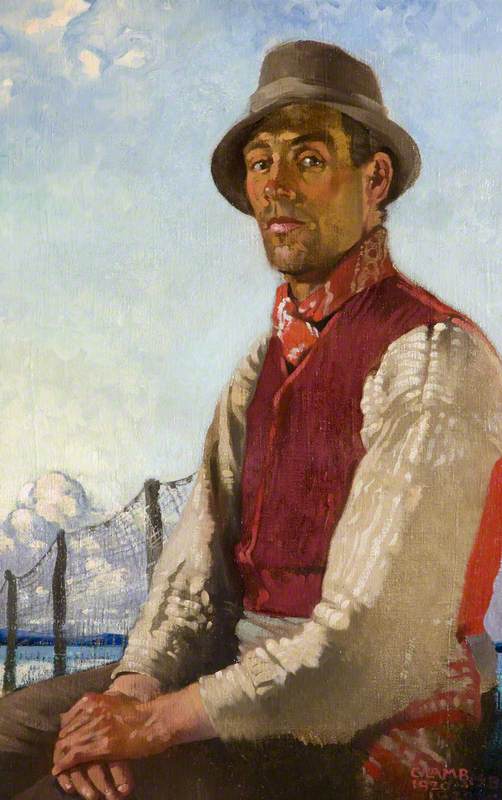
Charles Lamb, A Lough Neagh Fisherman. National Museums Northern Ireland.
I cannot remember how I met Charles Lamb, but he came down to stay with me at Crawfordsburn, and he painted the Inn sign. I had a beautiful sign, and it was the only sign in Ireland painted by a member of the Royal Irish Academy. Now they’ve lost the damn sign, or it has been destroyed; it is not there anyway. It had the drawing of a ship because the inn at Crawfordsburn was the half way house between Belfast and Donaghadee. That was when the mail packet boat ran from Donaghadee over to Scotland. I thought the ship would be a good idea because of it, and Charles did that. I got to know him well and I used to go down to Carraroe every year and a stay with him. He was a marvellous man.
I am very fond of this picture, it has been here for twenty odd years, since we came into this house. It was painted by Charles. He lived in Carraroe in the West. It is a painting of the Currach race, which occurs every year in Curraroe. A much lauded little race which, once a year, proves the best oar amongst them. I bought the picture from him years ago. I bought it because I thought it was so good, worthy to be amongst those sent to America for an exhibition there. That was one of the ones we sent out. When I stayed with him, I would always go over to the Aran Islands for a few days ona hooker. There is a hooker there (pointing to another Lamb picture).
On Aran I used to stay with Pat Mullen, an actor in the film “Man of Aran. Staying with Pat, I would go up to the pub and get a bottle of whiskey. Pat and I would then sit having our breakfast with tea, bacon and eggs, and whiskey in the tea. There was a beautiful girl living with him. She wasn’t the maid; she was tall and attractive with long dark hair down to her waist, but she was an Irish girl. One morning, when she was walking away from the table, – she didn’t sit down and eat with us, not for any reason other than probably modesty, – I said to Pat, “You know, she is a lovely, lovely woman”
He just turned to me and said, “She bakes the fine bread, you know”
That was all he said so I did not say any more – he just wished to keep quiet about her. I went down every year to Charles Lamb, and I bought a lot of pictures from him There are one, two, three, four, – five or six in this room, and I have given some to my children. Brian has some in Australia. Neil has some of his in America. My ex- wife has some up in the North. But I lost some in the fire. We had a fire in the North, and I lost two very fine pictures of his, painted in Brittany – wonderful old rustics with armfuls of chickens. Marvellous paintings, but I am afraid they got burnt.
The Guinness Family
What an admirable organisation Guinness is. I feel indulged that I have got to know and admire so many members of the family. The very Willies Jeep station wagon, that was being filled with sacks of malt combings I bought at the sale of things from Glenmaroon. When the Hon. Ernest Guinness died, his great house was donated to NES the foundation of a school. That family has done so much for Ireland. They rebuilt St Patrick’s Cathedral, they built bath houses for the brewery staff, up to date flats, even the present Irish Foreign Office house in St Stephen’s Green was a Guinness house – the list just goes on. The Rose of Tralee festival – there would have been no Rose but for Guinness.
I spent many happy days and nights at various Guinness houses. Luggala that unique place in Co. Wicklow with Garech Browne and his lovely Indian Princess, and his mother, Lady Oranmore and Browne. Always full of most interesting people — people, in the main, who contributed so much to the cultural side of Ireland.
Garech sponsored The Chieftains – Paddy Maloney, what a character!! Gerard Hanly who wrote exciting books on the African Masai – painters, poets and cultured critics. Clandeboye in the North, is another wonderful house – and in Ireland when we talk of a “wonderful house” we mean a place where you’ll meet interesting and memorable people. Leixlip Castle, Desmond and Mariga Guinness were another outstanding example, founders of the Georgian Society — they were responsible for saving many beautiful houses in Ireland. They restored Castletown among many others.
South Africa
During the war, one of the many interesting and lovely friends that I met was a South African Scot who was in the RAF. In Belfast we used to talk a lot about the Cape and he encouraged me to go there. So in 1946, as the war ended I set off with my new, second, half Scot, half English wife Helen, and my small daughter Ann on the Windsor Castle for Capetown. A lot of luggage, and a container of picked pieces of our antique furniture and Persian rugs accompanied us.
The trip across the bay of Biscay and down the West coast of Africa was the most exciting and interesting journey I had ever made. The arrival in Capetown with that incomparable background of Lion Rock and the Table Mountain is beyond my description. I am sure there is nothing comparable in the world. We stayed in an Hotel in Camps Bay – excellent food – 8 course dinners and very impressive uniformed’ Indian servants.
Dear old Jack Bowie lent me one of his motorcars, an American Hudson. He introduced me to the agent for Packard motor. An Irishman from Sligo, he sold me a Packard straight eight coupe. That was my dream car, and the most interesting that I ever owned. We did many great tours all over South Africa. I could hardly believe it all- away from the food and petrol restrictions, enjoying the fantastic climate, the freedom. I thought – this is paradise.
We did the long trip up to Rhodesia to Salisbury, to the Mickle’s Hotel to be with, for a while, my old friend, The Hon. John North, who was involved in the tobacco business. John subsequently became godfather to my son Brian, who was born in Capetown. Writing this, I am doing the whole trip again in my mind – the Kruger Park, the Karoo, the Drackensherg, and more and more.
I bought a small house in Somerset West with a big garden and a garage for three Cadillacs with a view of Gordons Bay.
One night at a dinner and dance in the Club in Capetown, I felt a strong hand on my shoulder whilst whirling round the dance floor, and there was Jimmy Legassic, ex Royal Navy Commander who was a great pal in Belfast. He had taken over command of the South African Naval Training College at Gordons Bay, just beside us at Somerset West – we had great times together, fishing in the Bay and dinners in Hermanus.
My son Brian was born in a Nursing Home in Capetown after a couple of urgent trial runs across the Flats from Somerset West. He spent the first two or three months of his life in the sun of South Africa. By then I had tired of doing nothing – I had made a lot of enquiries about various possible ways of earning a living again. I had never had time for such a, or indeed for any, holiday before. Many times I thought I should have stayed longer and done more research, but there was always a fear that it was all too good to be true. So it was back to the old country. I was reminded of what an old Irishman who had spent most of his life in America, and made money, said to my father, who had asked him why on earth had he decided to come back to poor Ireland. His reply was “well, you know the snipe was born in the bog and the snipe returns to the bog.” So, like him, I weakened and fell for the pull that Ireland has – and by God it has some pull.
I didn’t exactly go back to a bog.
Ireland
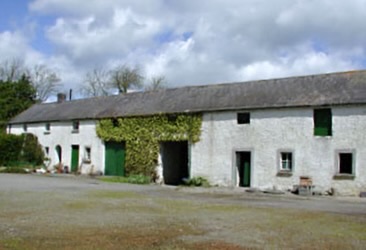
Cloncarneel House, County Meath
I went back to County Meath to farm. I went back to the very area from which we had been pushed out of in the late fifteen hundreds. The place was near Kildalkey and had over 200 acres of exceptional land (not so exceptional for Co. Meath), a superb eighteenth century house, in need of work and love. Here we settled and here the rest of our children were born. Of course it wasn’t as sunny as South Africa, but it had so many other lovely things and for me it was like completing the circle.
I decided to build up a herd of Kerry cattle – they would love the rich land of Meath. They are an old Irish breed, who are renowned for health and rich milk, with no proclivity to tuberculosis. We got to 120 head and a milk yield of almost 1000 gallons per lactation. We also made cheese and grew fine crops of wheat and barley. I made trips to Kerry to buy stock and to keep in touch with other Kerry breeders.
We used the Ministry Pedigree Bulls (A. I.) and I well remember my cowman calling me one morning to say “the man is here with the Bull in the handbag.” Well, the bull in the handbag kept our stock in high class form.
The pasture in Meath is noted for its richness. A Roman who came over from England in 400AD reported that the cattle could only be allowed out to graze for a limited time or they would “blow”, so rich was the grass. We named our calves after the wines of France – so a lot of Latour, Lafite and Haut Brion saw life in Meath.
Quite a lot was drunk there too, not always Latour! Social life in Meath was somewhat limited, because of the farm and family demands. However I always had my weekly Thursday in Dublin, when I went to Guinness’s great brewery to collect my ration of malt combings for the cattle. I would sit enjoying a pint with one of the brewers whilst my jeep was loaded and the talk and the drink were good.
Anyway back to the farm in Co. Meath. My farm was called “Cloncarneel“. It means in Irish (Cluan- meadow, an carn- aeiol) “The meadow with the limestone hill.” It was a beautiful Georgian house built about 1800 to the design of Francis Johnston. It stood in front of, and was linked to an earlier 17th century house. It was all elegance – a piece of Haydn-Mozart in architecture. We used to play the records of these masters whilst drinking a glass of pre dinner claret on the lawn in front of that piece of good mannered beauty.
I remember reading from a piece in the Cromwellian survey – he is said to have had eleven hundred surveyors and tallymen who listed the details of the Irish Estates and noted their value. It said “the manor of Cloncarneel – so many acres of meadow lands, so many acres of ploughlands, and so many acres of woods, etc., now in the possession of one Edward Scurlogue, an Irish Papist.” I couldn’t forget to connect this with the memory of that grim painting by W. S. Yeames in the time of Victoria about the time of the Cromwellian civil war in England, when, in perhaps a similar house, the Cromwellian guards were questioning the little boy – asking “when did you last see you father?” That little boy was the great-grandfather of the husband of a neighbour of mine – another well-known painter.
I was always deeply interested in history, and, by heaven, we have a lot of it in Ireland. I gave my first son Brian (who was born in Capetown) his first birthday on the Hill of Tara pointing him to the four cardinal points with the tears of joy running down my face. O Fallamhain, and again on Tara after 1,500 years. Of course it is all a bit crazy but,.:.
The first Brian who was the eldest son of Eochaidh Muighmdeadhoin in the age of Christ 358, had four sons,- Brian, Fiachra, Ferghus and Oilioll. By his second wife Carinna (the Saxon) he had Niall – that most illustrious of them all who was High King in the Sovereignty of Ireland. This monarch had two wives, Mongfinn, daughter of Fidhach of the royal family of Munster, with whom Niall of the Nine Hostages provided Ireland with great kings for 1000 years.
That is all from The Annals of Ireland by the Four Masters. It is one of the most respected histories of any country in the world. So I suppose it is only a very human failing to be impressed by what it records, even if sometimes I cannot pronounce the names of these ancestral tribesmen.
Elizabeth Ann, my eldest daughter, was born in the North and went to school in Dublin. Niall, my second son and Sara Catriona were born in Dublin at the famous Rotunda, the first great gynaecological hospital in the world. Ah, but you must see, Ireland had a few great “firsts” – Dean Swift’s mental hospital St. Patrick’s, and that lovely touch of irony when he said at the founding of it.
He gave the little wealth he had
To build a house for fools and mad,
And showed by one satiric touch
No nation wanted it so much.
It is still going strong and doing great good work. My wife spends a lot of time working for its progress as one of its “friends”. The Master of the Rotunda who attended the entry of my children into this phase of existence was Dr. Thompson, affectionately known as Bolivar Thompson from the village beside us in Meath and our own Rector’s son.
While checking that Dedication by Swift I got carried away for ages by his wit and wisdom – from “The Furniture of a woman’s mind” to an argument to prove that the “Abolishing of Christianity in England could be attended with some inconveniences.” I often wonder what he would say, if he were here now, about human behaviour and indeed Church behaviour where the emphasis appears to be on dogma before ethics. He did say in the seventeen hundreds “we have just enough religion to make us hate, but not enough to make us love one another.” I hope that both Rome and Ian Paisley take note.
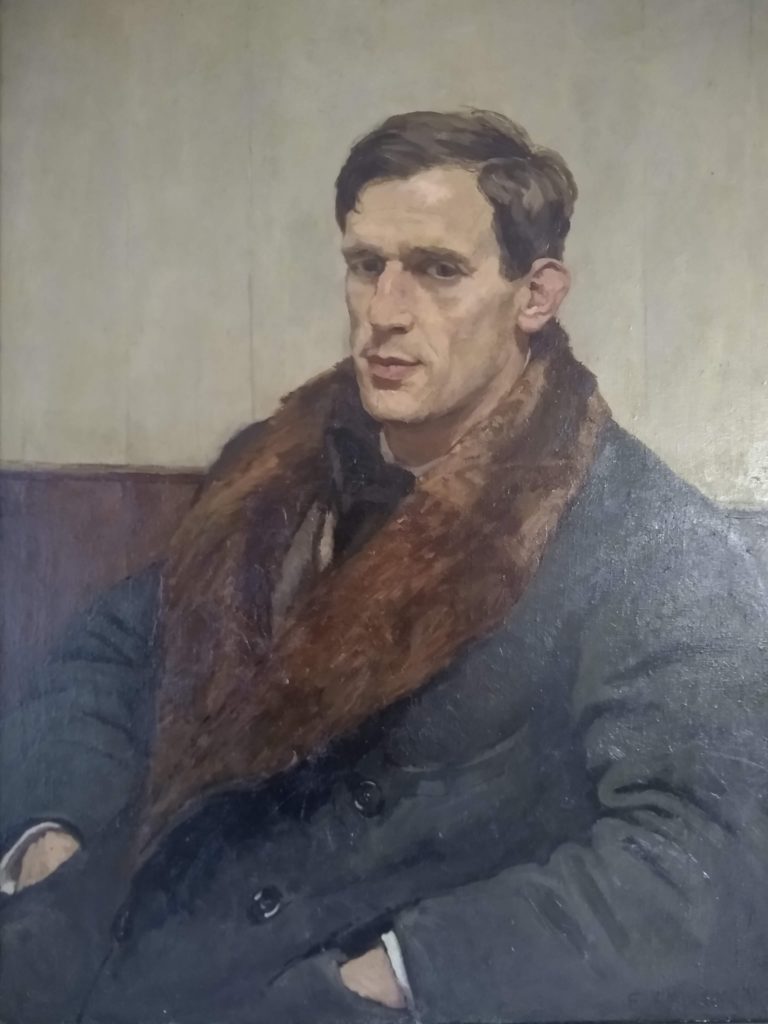
Portrait of Dr Bethel Solomons by Estella Solomons ©The Trustees of the Estate of Estella Solomons
Another great character in my Meath and Dublin era was Dr Bethel Solomons, also Master of the Rotunda and a great sportsman – he hunted with the Meaths until well into his eighties. He held a wonderful “open house” on Sundays, at his home just outside Dublin – I was one of the privileged invited. He told me a lovely typical story connected with the Rotunda. An old friend of his who was Master of another great gynaecological hospital in Vienna was over in Dublin, as his guest.
He said to Bethel, “You know, my dear Bethel,- even in old Catholic Vienna we don’t have many women who perform the natural cycle of having a child every year.”
“Ah,” said Bethel, “wait until you come down to my Hospital and I’ll introduce you to a dozen or so, all of whom had 18 to 20 odd children and are great ould characters, full of life and fun.”
So next day he brought his friend to the great Rotunda and in the “outpatients”, there they were – Bethel took him round.
“There is Mrs. Flanagan – she has had 16, all now alive and well, and just look at herself, isn’t she a great one. Here is Mrs. Bridget O’Hare – just look at her. She has 18 – all alive but one – he was killed in the first war. And now here is a truly grand old girl, areal Dub. She had 20.”
The old Viennese was overcome. He hugged the dear old girl, and stuttered in his broken English.
“Oh, ziss is marvellous, it iss vonderful, how did ziss happen?”
“Ah,” says she “Doctor, don’t be pulling my leg. Shure half the time wasn’t I sleepin’ and he drunk?”
Dear ould Dublin. Sir Edwin Lutyens designed and built the finest War (1918) Memorial Park in Europe in memory of the Irishmen who fought and died for the Empire, that so many had worked to build. By some narrow (unlrish) quirk it was not acknowledged and fell into partial ruin. However, now in 1990 it has been magnificently restored and is maintained with devoted care. Yes we have had our ups and downs, but now, thank heaven and the memories of an old civilisation, we are on a noble road again.
One day my old solicitor telephoned me. It seems so long ago – we actually had a telephone, Kildalkey 4. It was to be a far-reaching call. He said that a brickworks (Northern Brick) could be bought – worth the money, would I come up and look? So up to the North I went – I was thrilled at the thought of getting back to the world of building and architecture. I had finished the renovation of Concarneel, and given a further lease of life to Frances Johnston’s lovely house, and I suppose I was hungry for more. IJ did not want to leave Meath and the house and farm and the Kerry cows and the poetically named fields. In Meath they are called divisions of land and carry descriptive names in Irish, like Mullahoran (the hill of the barley), Clon-a-woolan (the meadow of the little hills) Clon -a gownah (the meadow of the milking cows) etc.
Anyway I was warned that if I left to go North the Land Commission would take over the place, and divide up the land. There was a big push in this operation at that time and the land was being parcelled out in smallholdings, mainly to people from the West, and the procedure was very active in that part of Meath. I was angry and cursed the politicians, I often did, before and since. I sold the place to a friend in the North who had decided to move South of the Border.
Northern Ireland – Dunadry
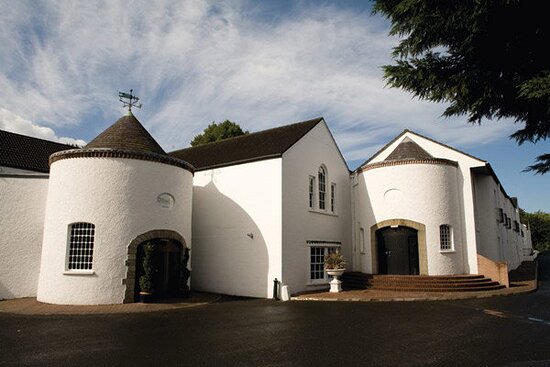
Dunadry Hotel & Gardens in County Antrim.
I moved up North, (in the 1950’s) and bought Northern Brick and Northern Sand and a lot of land on the shores of Lough Neagh. I bought a house outside Belfast – a real “Lupin Pooter” house with some furniture pieces and a lot of linen sheets, and heavily embroidered pillow cases – it was a pretty dramatic change from Frances Johnston’s classical elegance. I did a minimum of work on the house and garden, but I had to make a more up to date kitchen. The builder, a decent local man, advised me in that quick direct Belfast way- “make it easy to keep clean, cover the tables and benches with that new ‘ Formica ‘ board – it’s a great man altogether.” So formica it was and “mind you, it was quare and nice.”
The brickworks was demanding, there was very little time to think of “graceful” living. New improved plant was vital, better methods of getting the Lough Neagh Sand – we made Sand Lime Autoclaved brick. The demand was good, – great. Ulster was booming, new housing, new schools, new hospitals. The government in Ulster was helpful and gave great backing to industry with liberal grants for up to date machinery. I took advantage of all this and expanded until our capacity was up to 1.5 million bricks per week. I had a great bunch of workers and we worked a day and a night shift. For almost 25 years I had total works harmony. I had no directors, I was sole owner and I had no big debts and no mortgages.
While this was going on I was tired of the “Lupin Potter” house and I had advertised for an old mill or barn near a lake or river, and near the works. This was really quite early on, less than one year, and so this new development took place whilst I was expanding the works. Looking back I wonder if it was all true and how can one be so greedy for work. Anyway an estate agent telephoned to tell me that he thought he had the very place for me, and could I meet him yesterday. I said No, but, I’ll meet you tomorrow.
As he drove me down to the very road I used to drive to the works, near the town of Antrim, he said, “l have an old mill here, and a village.”
I said “Now, look, I haven’t got that kind of money. What are you trying to do to me?”
“Well,” says he “I have the old mill and I have the village, and I have the railway station and the river, and nearly 20 acres of land, and I am nearly going to give it to you.”
The village was Dunadry (20 houses), the mill was the old Linen Bleach works dating back to a print works, 1660, and the river was the Six Mile Water. The houses were all occupied and the rents were 6/- per week and hard to collect. When I saw the old mill and the river I was captured. I knew I was lost, and I didn’t think of the sitting tenants in the houses, and the liability, – I would have to keep them maintained.
The mill buildings, lovely stonework, got me. It was vast but I could see the part that could make a delightful and fascinating house. It was there and waiting to be lifted out of the medley of stone ruins. I won’t put down what I paid for the whole lot, but it was very little, but then, where would that agent find another crazy dreamer like me who would fall in love with such a set-up.
I took my wife and 2 (small) sons to see it next day. Helen looked at it and looked at me, and looked at it, and then looked at me looking at it, – but she didn’t shake her head and I took that as a compliment. A travelling circus had parked all their equipment there and of course the boys were hypnotised, shouting “Daddy, will the Hobby Horses and the big Swing Boats always be here?.”
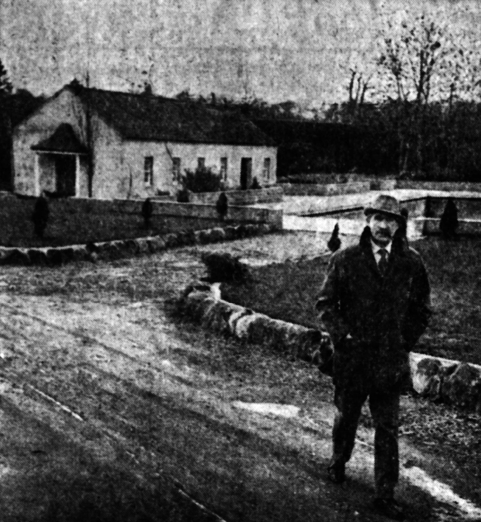
Paddy at Dunadry, Co. Antrim, Belfast Telegraph, 11 January 1963.
I started almost at once to demolish the unwanted buildings including the 80ft. Brick Chimney – and there’s a tale to that. A friend of mine, an army officer, said “Oh, I will ask one of our officers who is good at that sort of thing – he could drop that in no time.” So one morning a very smart gentleman with his swagger stick under one arm and a Pekingese under the other marched down with me to the edge of the river where the great chimney stood — He said “oh yes, my chaps would just love to do that job, I suppose you are not worried about that cottage beside it at the river side – it might be somewhat shaken”. I said, “Well I am, for I propose to give it to one of my sons as his first nest.”
That ended the army affair.
At that time I had a man, a steeple jack, and an expert on Mill chimneys, from Belfast, working on the Brick flues on the Lancashire boilers at the brick works. He came within a day or two – no swagger stick and no dog. He took a good look at it and he just said “now where do you want her threw?”
I knew he knew and of course he felled it within a yard of the area he determined. He came from an area in Belfast called Cromac Square, which they say, is so tough that they play “tig” with hatchets. The North is a great place for getting things done – They know their work and they keep their word.
Now the next thing was how to get rid of the tenants. The rent they were paying was no good. If a slate came off, I had to put it back on, and if their privies went out of order I had to look after them. Yet I did not want to appear to be a really hard landlord. There were dry privies charmingly built over the millrace. I wanted to use the millrace and put a turbine in there, – there used to be a big wheel, but in that brilliant way they worked during the war, the wonderful big water wheel was taken away because they needed scrap iron to make bombs during the war. They cut down the railings of houses and they took the mill wheel away.
I went and saw my friends in the Ministry, and asked their advice, – what could J do? They said “Well now,” – they knew me since I had spent my time there during the war. I knew most of the senior ones and they were very sympathetic.
They said, “There is only one way we can do anything that might help you, and that is if the village has no architectural value, or is not a thing of importance, we could rehouse the villagers in other houses, and you could demolish the lot.”
Well, they did that, – it had no architectural importance, and they could not have been more helpful. The tenants were all housed in council houses. They had had no proper lavatories, nor running water, and to have acquired these luxuries was indeed a gift from heaven. These dry closets along the mill race were something! It was a fairly long drop, but never mind, it worked! They had a pump in the village, an old cow tail pump, and everything went quite well.
One charming old lady, – she didn’t want to move even into a nicer place, a council house, and to prove her point she started painting her cottage, doing it all up. We had demolished everything all around her, and she was the last there. I went up to see her one morning, and I told her “I have great news, I’ve found a lovely place, and J think you will be very happy init.” “Mr. Falloon, where is it?” “You’ve heard of the great flight of wonderful steps, leading up to the main door of heaven, where Peter sits. Well, it is just on the right hand side of those steps.” She roared with laughter, and she said “Ah sure, you’re a terrible man”. So she went, and she gave me a present of bits and pieces out of her garden, so it was all right.
We tore away, I love the vernacular, and soon we moved into the old mill House. With the river in front, I put in a water turbine which made 15-18 KW auxiliary house heating.. Having demolished the village, I built the hotel. It was the first hotel as such (not a conversion of houses into a hotel) for many years in Ulster. I was in my element.
We planted trees and shrubs, and made a swimming pool. I always remembered my father’s saying – when you grow up don’t pay too much attention to race or religion, and that sort of thing – you’ll meet only three kinds of people The Improver, The User, and The Abuser. I had always tried to be an Improver and by heaven I needed to be very “close hauled” to be the “Improver” at Dunadry and Northern Brick.
Anyway, we demolished the village. I demolished those parts of the old mill which were the ‘offices’ and the oldest parts. Here was the lapping room, – they used to lap the linen after it came in from the bleach Greens. I kept that, and I rebuilt it, and made it into a house to live in.
We had a head office in Belfast, and I don’t like cities, neither Belfast nor Dublin. I wanted to get out of that as soon as I could, so, I moved the head office of the brick works into Dunadry. The station area was derelict, trains didn’t stop there, they just went through. In the olden days they used to stop there, but they didn’t in my time. But there was a railway house. This was a cottage where the senior porter or manager lived. Here I put our head office.
At that time the North of Ireland was booming, building factories. There was a great Dutch factory being built in Antrim, and I had connections, because I was supplying the bricks, and I was also storing in my works a lot of their machinery until they had the place ready. They enjoyed inviting me. “Come up to the house for a drink” at night, sometimes for supper. They used to say, “You know, it is crazy, we are only three miles from the airport”. The Belfast airport had just moved out to Aldegrove. Nutts Corner it was called, not after the thing you eat, but for the man who owned the land. “Why don’t you build a hotel?” They knew that I had a background, that I knew Crawfordsburn and that I owned Crawfordsburn, and that it was the first of its type. And, of course, that put the notion in my head. I started to build Dunadry, which is there now. It was more elaborate than Crawfordsbum. We had sixty suites. You had your bathroom, and bedroom, and a little sort of dressing room. I did it deliberately for people who were doing it on expences, the new aristocracy, who are now sniffing wine, telling you whether it is this, that or the other, while the poor wife is back in Bermingham, probably having scrambled egg. That is the new lot. They are the only people who can afford to spend – they charge it to their accounts. The hotel was a great success. We had 98 ofa staff there. It was really quite a big business.
I designed it in the vernacular Irish style, long, low; white washed, simple, clean looking, and inviting, – no ostentation. It was the music of Bach – no frills, but as comforting as the diapason of the seashore. All the training of my dear, now dead architect friend, Denis O’D Hanna came back to me – it had never really gone. It was a great success, and I had wonderful workers. We had a party for them all, just us, to mark the first opening. Paddy McLarnon, the foreman of the job, a man unique in diligence and superb in humour played the Brian Boru pipes; the wives and girl friends were tarted up and danced the jigs and the sexy fox trots with grace and delight, which did justice to their wine. John Kelly, the foreman joiner chewed his tobacco, and looked on his work with mature satisfaction — he was then just past 80. It was a great night and a very happy start to what was and still is a very prosperous Inn. Yes —I called it Dunadry Inn.
Thinking of dear old John Kelly brings to mind a tale about him. He was foreman on the making of the formwork for the principal bridge on the railway to what is now the airport. After the official opening a group of the workers met in a pub in Antrim and they pulled his leg at being at the “official” opening. ” John”, says they, ” what did you feel about it when you saw the first train going over – tell us, was there a bit of a declivity at all?” “Ach no”, says John ” if anything she ris.”
I had moved the head office of the Brick and other companies from Donegal Square in Belfast to Dunadry, and then, with a small and competent staff we ran the companies. I was not without anxiety about the resurgence of the R. A. and others.
I am perhaps too sensitive about this madness in the human race. I just cannot see why we are never able to settle our differences by reason and argument, – why must we always kill and destroy? Surely we should know now, after centuries, that in the end we have to sit down and argue it out – without the bomb and the gun. I’m afraid I see the Church and denominational religion as very divisive when they ought to be the very opposite. They should be more concerned with ethics and less with dogma.
A lot of things happened during my last years in Dunadry. My wife and I parted company, which was in fact probably the biggest thing in my life. I met Jane. Jane is one of the most wonderful people I have ever known. She uses her education – she uses what she learnt in Cambridge, in life. She has used it to advantage. She has an excellent voice and was trained in Vienna in classical singing. She sang in Glydebourne, and has continued to sing in choirs in this country. Her interest in History is aided by a very good memory — she remembers what she reads. Kind and loving, sometimes she forgets to say “Goodnight” but then I prod her in the back, and all ends well! I could say lots of things. I think that she is wonderfully straight – forward. She does not hedge about things. I do not know how you can qualify why you love somebody. Either you do or you don’t. She travelled a lot. When her father was in America during the War, she was with him. She learnt to drive there, so she is a damn good driver. She drives through London in a way that nearly drives me out of my mind, not because of its speed but of its cuteness! I could say many good things about her, and I would mean them all.
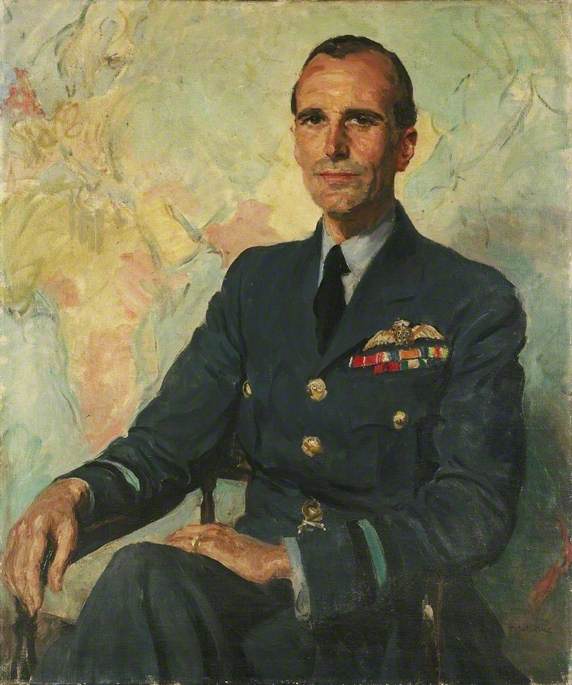
Air Commodore Robert Victor Goddard (1897-1987), CBE, painted by Thomas Cantrell Dugdale (Imperial War Museums). A senior commander in the Royal Air Force during the Second World War, Goddard is perhaps best known for his interest in paranormal phenomena. He claimed to have witnessed a clairvoyant incident in 1946, upon which the feature film The Night My Number Came Up (1955) was based.
I suppose that my dislike of cities was an imposition on her. Here we are now living in County Laois, miles from Dublin, all because of my love of the country. My eldest son lives in Australia, in Noosa, a really beautiful part of the country. It is the Palm Beach of Australia, north of Brisbane. He built himself a rather nice house on the coast, and about three or four years later he sold it. [ asked him why he had sold it “Oh,”he said, “I could not bear to look at other peoples houses” He was born in the country and was reared to look out only at trees and animals.
I love and I admire my wife, but I think I would have married her father if I hadn’t married her! He was Air Marshal Sir Victor Goddard. He saved the British Isles, and organised the small boats for Dunkirk. He flew over on his own (I can picture him — he had a great sense of humour too,) to Naval Headquarters and the Lords of the Admiralty said.
“We have two destroyers ready to come to extricate our men, they will take 45K maybe 48K”.
“I have 390,000 on the beaches, and I want every man in England who has a small boat, even a canoe to take one, to get over there as quickly as they can.” My father- in-law said.
At that the stuffy old Lords of the Admiralty said. “This coming from a senior officer. What, what! Small boats, even a canoe! What! By God!”
He worked at it for a whole day until he got their permission. He was a lovely man, brilliant, and he had a wonderful air force career. He was an Air Marshall and a very psychic man. He was a great believer in spiritual things. He was also a great social credit man, for Economic Reform. I used to say to people that if it were not for my father — in- law you would be speaking damn bad German.
Shakespeare gives me comfort when he made Hamlet say
“There’s a divinity that shapes our ends
Rough – hew them how we will.”
Jane’s father was one of the outstanding people during the war.
Jane and I made our first home together in England. I eventually bought a place in Wiltshire, a lovely old manor house, – bought it for nothing — in those days things were very cheap. The M4 hadn’t been built – it was in Wiltshire but nowadays it is in a direct line to London. Then it was a really lovely old place. Jane had her children at school in England and her ex-husband was very much against them coming back to Ireland. All that encouraged me to buy a place in England, which I did. I didn’t spend much money on it — it didn’t need much money to be spent on it. It was very beautiful and it had belonged to a Canadian multi- millionaire in the insurance world who had no children, and, when he died, his wife sold it to a funny type of man who went bankrupt and I bought it from the Westminster Bank. That amused me. ButI used stay for only two days out of five; and fly back I still had the inn and the brick works, the sand company — six companies, so I had plenty to do.
It is easy now to look back over all those years (over 25 of them) and think of the mistakes and indeed the serious misjudgments one can make. I sold the manor house – quite well, but for nothing compared to the mad prices of English property a few years later. It is now a Country House Hotel, and valued well over the million.
Of course I try to forgive myself, and of course I manufacture all sorts of reasons, but, in the end, I have to admit to myself that the real cause was my inability to “settle” in England – I could not define that in exact terms. Maybe it had something to do with the size and density of population, and the aptitude of their civil servants to say “no” to so many lesser things that kill the flight of the impatient enthusiast.
You see, I never played cricket – my patience is limited The real turning point came when the boys, Brian and Niall, came back from University. Niall went to Trinity and from Trinity to Harvard. He came back and said, “I’m not going to stay in Ireland.” Brian wouldn’t stay in Ireland either. He felt that the whole threat of the IRA was too much. He could see no future init. I was too emotionally in love with it all to see it the way they did. They had a much clearer view of the thing and of course they were right. I decided to sell the whole thing. Eventually I did at a very poor price.
I sold the brick works and the sand co. to a very big English concern. When I look at it now I think I sold it for next to nothing, but one has to remember that at that time with the threat of the IRA continuing — nobody was buying anything. I sold the hotel and our own house, The Watermill to a Belfast family for very little. But I have ached in my heart about this for so long that I have forgotten about it now.
At our peak in the Brick Works, we were doing all right. We were making 1,000,000 bricks a week, which was better than anywhere in the North of Ireland. That sounds boastful, but it was the truth. So that was it.
I was a great member of Economic reform. It was called Social Credit. It was tried out in a province in Canada. Jane’s father was very interested in it too. The whole idea was an examination of the Economic schemes run by International Finances.
Of course that came to nothing. It wasn’t big enough and people were not interested. The Bankers were creating credit, and their interest on that was repaid by increasing the taxes, and especially the rates. We have no rateable valuation here on houses, and in some cases towns had to pay more interest on their money than they received in taxes. They then had to borrow. All countries seemed to be condemned to collecting taxes from people who raise money on their wealth. Social Credit was attempted in one part of Canada, but it did not succeed. The Power of International Finances suddenly to be able to create millions of pounds. The whole idea of Social Credit could and should be revived.
During that time I was honoured to serve on The Ulster Tourist Board, The Architectural Heritage Council, and The Ulster Arts Council. The Royal Society of Ulster Architects made me an Honorary Fellow – that was a big compliment.
I also served on The Ulster Countryside Committee – this was indeed advanced thinking by the Government – to set up such a committee. Its purpose was to monitor and check the preservation of the countryside, and to discourage unnecessary building in areas of Natural and outstanding beauty. Indeed it was to discourage unsightly buildings or groups of buildings to be erected anywhere. We aimed to camouflage them with trees. It had a noble aim -“To keep the countryside beautiful”. It worked and generally we got great support. I often wish that the Southern Government had done something similar. We needed this, especially in coastal areas – places like Donegal, Kerry, indeed all over the South and very especially the environs of Dublin.
Our great character and much loved man, Michael MacLiammoir wrote in the foreword of a pictorial book on Ireland. “In this country of ours, where the ear is always more sensitive than the eye.” Yes, he had it well summed up – and we talked while the “developers” made money anda mess. I am a dedicated countryman, but I am very aware of the problem of housing the moderns who all appear to want to live in or very near towns. This was not a native Irish trait. In the very early days, we had NO towns or even villages. The Danes built our first towns. We were individualistic; we did not like looking into our neighbours walls and windows. Our native cottages were whitewashed with a golden thatched roof that fitted sympathetically, as a flower in your buttonhole, with the grass fields, the whins, and the thorn blossom of the countryside around you. It is so easy to destroy a landscape and it is almost impossible to correct that sin after it has been covered with concrete boxes.
The Northern Ireland Housing Trust actually brought in a special machine so that they could move mature or semi-mature trees to adorn, or, as they would say, “set off” their housing estates. Yes I am sure I sound too pessimistic, but I am depressed by a lot of what I see. I do not like the modern city with their characteristic suburban sprawl. I do not like Punk “music” with a thousand decibels, and I do not like modern television, with its damnable tendency to all kinds of violence. Maybe that errs too much on the negative side, but you see I do have a very deep and sincere appreciation of what the technicians have done in advancing and improving beyond belief our ability to play recorded music. We can now hear the greatest orchestras in the comfort of our own homes and in our cars when we are bored almost to sleep on the motorways. Remember the old 78 – it took a suitcase to carry one opera. So there is evidence of a new kind of artist creator, and it is so good to pause and give him credit and call him an artist, even if he does not have torn jeans and wear a ring in his ear or in his nose.
Independent Television (UTV)
Ulster came late, if not the last, in the dishing out of the Independent Television licences. I was almost unaware of this new electric Svengali which was going to play such a bewildering, indeed terrifying part in our lives. I do not think I dare write down what I think of it now, but I am acutely aware of its power. Anyway my very dear old friend, Billy Mac Quitty who left to live in London and became a writer (and brilliant photographer) about Egypt, and the lovely high breasted long necked Nefertiti and of course the death palaces of the Nile with their rows of solid Egyptian columns. (What a wonderful job the Greeks did when they civilised them with acanthus leaves.) He then became a film producer with a number of films to his name, including the great one on the Titanic – “A Night to Remember”. He arrived at Dunadry one early morning, and before we had finished our sup of Bushmills, he had me in a State of wild excitement – he told me he had been working hard on the idea that we must (ought to) get this franchise. We knew Ulster, we know Ireland, and we know the sort of people who would make this an outstanding station. Oh, he had sold me the idea long before the Bush was half way down the bottle. We needed £300,000 for a start and we needed a small group of first-class people who would impress the “authority” in London.
Well I started on the £300,000. I rang my old friend Ivan Pollen, a lawyer, first. He said “put me up for £100,000, then another friend and neighbour, George MacKean who said “put me up for £100,000”, and the dauntless Harry Catherwood – he said Bot eters, “Paddy, who’s travelling”. I said Ivan for £100,000. “Did you ring George? Is he travelling?” I said he is and for £100,000. “Put me up for £100,000.” It was as quick as that and very typical of Ulster. I rang Billy in London to tell him the news. That was indeed how it all started.
Now the next move was to form our group. We had our first meetings in Mr Catherwood’s office. I had from the beginning always thought that Lord Antrim would be the ideal chairman. He was a friend and he was a great good man – high standards, wide knowledge, and had many connections. I put it to him at one of our early meeting – would he be willing to accept the position of Chairman. He agreed. That was a great start. We then got Brum Henderson, whose family owned the Belfast Newsletter, one of the oldest, or, indeed the oldest daily newspaper in these islands, to come in and be Managing Director. Brum was bright and very enthusiastic. He did a great job. We were a well-mixed lot – Irish Catholic and Ulster Unionist – whoever said that we couldn’t combine?
We had noble ideas – to entertain, to enlighten, and to educate. I think it did a good job. I chided Sir Ivan Kirkpatrick, Chairman of the Independent Television Authority on its choice of the name. The word Authority was to me a rather equivocal definition of “Independent”. He replied in his charming way “Well, Paddy, you are independent of the BBC, will that not do?” There are still a few of the old board serving – but a number like myself are retired, having passed the ‘70’s. (Rule 798 Subsection 45) -!!_ Anyway U.T.V. is going strong after 35 years.
Milllicent
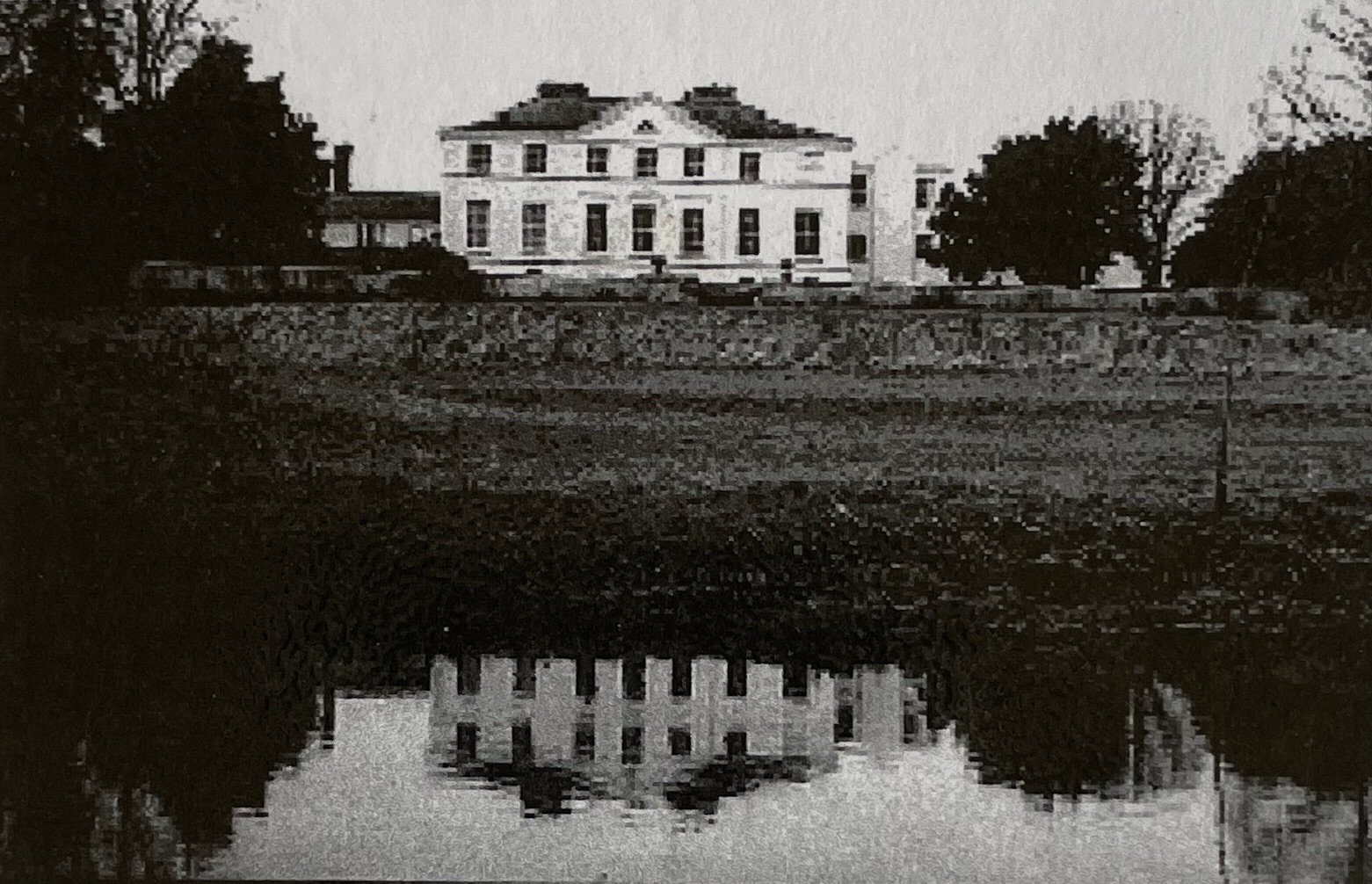
Millicent House, Clane, County Kildare
There was a lovely estate in Co. Kildare. The owner had died and the Irish Land Commission had split up the estate into smallholdings leaving the “big house” and 25 odd acres of meadows and woods along the banks of the Liffey. Like so many other historical and beautiful eighteenth century Irish country houses, it was left to die, – but somehow The Society of St. Vincent de Paul took it over and established a holiday school for young Dublin boys who came to stay at weekends, to breathe country air and to learn their catechism. One night, when their teachers were asleep, the young “Dubs” set a fire in the principal sitting room and had a great evening’s “crack”.
They went to bed but they had left too big a fire, which rolled out, and in a short time the whole South Front, was ablaze. No one was injured. The house was very seriously damaged. It was left to its fate. During subsequent years it was vandalised by nature and others.
On the other side of the Liffey lived a friend of mine who (and his father before him) owned the old and famous Royal Hibernian Hotel in Dublin. He was a man of taste and culture and had a great love of Ireland. He got word that a pair of Dublin “developers” had bought the old place and proposed demolishing it, and building 25 or 30 bungalows on the site. He was terrified. Such a scheme should never have been thought of, let alone become a threat. If carried to conclusion it would have destroyed the beauty and the sanctity of two of the most beautiful sites on the banks of the Liffey. Anyway the area was supposed to be preserved and protected, and indeed if one could believe that the Government Planning Department were dedicated to such an idea, then the threat would be of no consequence.
I bought the place from Mr. Kenneth Besson, the man who saved it. That was in 1974. I worked on its restoration with intensity for 3 or 4 years, and after 27 odd years, I still worked on it with maybe less intensity, but always a lot of love. The entire southern section of the house — the Palladian part was burnt out. Then it was abandoned and of course it was vandalised — it lay as a wreck. I bought it in that state and I spent four years rebuilding it. I enjoyed doing it so much, and no, I wasn’t terribly conceited about what I had done, but I was quite pleased that I was able to do it, as they say. I have never had one penny from any Government department towards the work, and of course, not a word of encouragement. Never mind, I and the other fools, – idealists, mad men or whatever we are called by the balanced, sane observers, will, Iam sure, go on regardless. Let’s call it conceit and leave it at that.
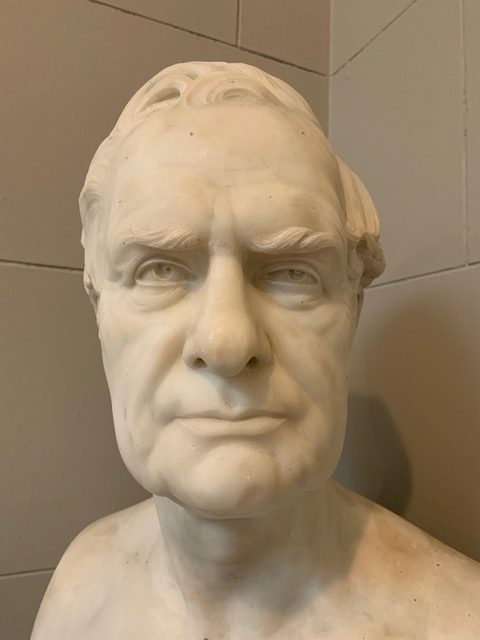
Sir Richard Griffith’s bust at the RDS
My friend, Ken Besson was not prepared to take the risk of trusting the planning department, so he had bought the property from the would-be “developers”. I believe he did a noble act that should be remembered and praised. It was the first step in saving for posterity a listed house and a beautiful site. It is as well a historical house. The main classical part was built in the 1700’s, by Richard Griffith (father of Sir Richard Griffith, Bart.), who moved here from [Maiden Hall – TB] Co. Kilkenny and bought Millicent Demesne. He was a United Irishmen supporter and friend of Wolf Tone when he took his law degrees at Grays Inn London. His son Richard, later Sir Richard, was one of our very distinguished Irishmen. He made the first great geological survey of Ireland. He was the Griffith of the Griffith Land Valuation. He was one of the early leading founders of the Royal Dublin Society. He played a leading part in the foundation of the National Gallery. It is written about him that for many years, from 1830 onwards, there was hardly a work of public importance undertaken in Ireland on which he was not consulted or which he did not personally superintend. One would have thought that the home of such a man (who played so many important and historical parts in our history which we are using and enjoying today) would have been noticed, acknowledged, maybe even photographed, but no, nothing. Nothing.
Jane and I kept on loving it all and doing our best to improve and conserve. We planted trees and shrubs – oak, beech, lime, and on the Liffey banks, aspen and whitethorn on the borders of the woods. The paths through the woods were a delight, starting with the early snowdrops, bluebell, wood anemonies, primroses, and masses of white garlic blossom. Stately swans on the Liffey and the fantastic blue flash of the kingfisher were our joy.
I think it was old Lord Halifax who said of Ireland “The finest climate in the world with the worst weather.” Well he had a point there, but in 1995 we had the best sunniest summer ever recorded. Generally I don’t complain about the weather – I enjoy the changes, wonderful cloud variety and colour. Our overseas visitors remarked upon these things with delight. They love the small winding country roads, the hills, the mountains, and the lakes – such an extended variety in so small an area, and then that extra blessing, – no great overcrowding.
So far our tourist development has not worsened the manners and civility of our people. They are still probably the most friendly and welcoming in the world
A Few Thoughts
I used to do a little broadcasting, but the “Authority” stopped me because I was a director, likely to say something controversial. We allow our masters to do so much to “protect” the masses that it will be a miracle if, in a few years, the masses will be able to do anything for themselves. An old London friend made what I thought was a profound observation on the modern scene. He said, only a few years ago it was the wealthy landowners and the top few that had a vote – now everyone at the age of 18 has a vote, the longhaired punk, the drug addict, and the buck that beats an old age pensioner and takes her handbag. People and the press said how wonderful, how far- sighted of England to introduce this law (she was one of the first to strike such a note for “freedom”). My old friend reserved the right to doubt. He summed it up so – “We now have a politically illiterate electorate.” — there is big scope here for the bossy bureaucrat. Brussels was then just another European city albeit with the best restaurants and the finest wine on the continent.!!
So we have got a very descending Society. I looked after my own daughter without a wife at the beginning. A most wonderful girl helped. She finished up when my Ann was old enough to go to school. Most schools are run by religious orders, making it difficult to find a school for one’s children without a denominational slant. Ann went to her first school in Capetown, run by the nuns, and the head nun was an Irish- Australian, and my daughter was the only Irish girl in the Convent. It was a very high-class snobby sort of Convent thing, and she got treated like a princess! Then she came back to Ireland, and I sent her to school in Dublin. My other daughter I sent to the Quakers. I wanted to keep them away from religion. I am mad on ethics, but I am not very mad on dogma. I have a great joke with an old friend of mine. He is a priest, a Roman Catholic priest, and when we meet we have great fun, he is very charming and I always say,
“Tell me, Father, when is the Church going to give up teaching dogma, and teach ethics?”
“Ho,ho, Paddy, that’ll be the day, that’ll be the day.”
I am more against now, than ever before, any form of religion. I think it divides people, it does not get them together. We have known this in Ireland especially, because it is so small, with a small population, and one knows so many people. I am sure it is much worse in countries like Italy and Spain. I am reading a book at the moment written about the time after the Reformation. It is about the early English land question, and about how people lived, and, even in England, how people starved and lived like animals. The book is by Barbara Hannon and her brother, both doctors of literature in Oxford; it has seven editions, the first one in 1911, and the last in 1948. It describes the treatment of the labouring classes in England, the effect on farming before the enclosures, and, finally, during and after the enclosures. Ironically the creation of the enclosures was called “civilization”. It is about barriers, fields in private ownership, and enclosed private property. It was terrifying for those used to roaming with their livestock at will through the countryside, and yet the people in authority were the local magistrate and the priest, and the priest was a Protestant.
The treatment of the poor in England, right up to 1840 was horrendous. One wonders how badly the British treated us when the famine was in Ireland, but they treated their own people a darn sight worse. Of course the enclosures changed the customary way of life for the poor people and the cottagers, and brought consequent poverty. They used to go into the common land for firewood, and so on, and, remember, they used to get the gleanings from the harvest, and it is rather interesting to quote the Bible, to quote Leviticus “There must always be something left for the gleaners and nobody must cut close to the corners of their fields, so that something may be left for the poor people to gather.”
I suppose we should not be surprised at the disastrous course of the human race in recorded history. For all the real notice it has taken of their teachings and warnings, great men, all the great men, might not have lived or spoken – from Lao Tzu (600BC) down to Mohammed a few hundred years ago. The greatest of these made it very clear and simple “Thou shalt not Kill”, no equivocation there, nothing about “except in uniform” nothing about “government decree blessed by the Church” and what about that wee touch, “turn the other cheek”? did we hear that at all? It is odd that the greatest killings have been in the countries professing to follow the churches that profess to follow the teaching of that great man. We should stop to think – do they really deserve our tolerance, let alone our support?
Remember the Churches were the early ones to murder and kill under torture to maintain their interpretation of what others wrote about what He said – since He Himself never wrote – surely that was astonishing arrogance, but maybe it fitted in with their power policy. And even now, all over the world, we are still killing because of our religious differences. Will we never learn? There has never been a period in human history when the danger was so great. We have, at this date (1995) “advanced” to such a degree that we have the ability to destroy all life – human, animal and vegetable on this little globe. That is almost beyond man’s ability to accept, but it is fact. Who is going to use the big club hammer to drive home that nail before it is too late? The giant armament nuclear industry is away beyond normal comprehension – how dare Governments try the bluff of calling it “defence mechanism”, It was old Confucius who, 500 years before Christ, when asked by the learned elders what would be the first thing he would do if he were to become the chairman of their Province, he answered “The first thing I would do would be to see that things were called by their right names.” We need a big dose of Confucius now with our modern slickness of calling a strike “industrial action”, when it is, of course, no action, and that other insulting piece of nomenclature “A people’s democracy” when it was communist dictatorship.
One thinks very often that maybe it’s too late for understanding that the main task is to learn and put into practice a code of ethical behaviour. We must be the only species who seem to enjoy killing our own kind. We have made it into a “full dress” play with bands playing, uniforms, and medals. We have even adorned our sacred churches with rows of banners to tell us how well we have done it. We destroy centuries of man- made beauty and tear down the evidence of centuries of civilisation – we now have the means. Our ancestors had only the sword and the bow and arrow, but they did their best. We must save ourselves and we must start now. Maybe the women will take the lead. Remember Sparta and how the Spartan women stopped the war by telling their men “no more bonking till you stop the wars”. If men had to carry their sons for 9 months, give birth, suckle and nourish them through infancy, and suffer, and love them into manhood, there would be no conscription and I believe no war. You’ll say – enough; I’ve said enough, but of course I haven’t. Anyway I will quit, but just one more point.
Postscript
I sold Millicent in 1999. Now I am here in Lansdowne Lodge beside Luggacurran in the County Laois. We live in a most beautiful and wide valley in the heart of south middle Ireland. The property was once owned by one of our early Norman invaders. They did what they always did — chose the best land and spent their lives improving it. They planted beautiful trees, drained it and loved it. They remind me of my dear father’s neat description. “There are three kinds of people — the user, the improver, and the abuser”.
I had my 89″ birthday on 10th July, 2000, (I have to admit that I do not like to admit to it). It seems that even more than earlier in my life I feel a very strong sense of depression at the behaviour of human society all over the world, and now, with television etc., we are constantly bombarded with depressing news. One cannot fail to be pessimistic. It is necessary to surround oneself with beauty, the beauty of the countryside and, enjoying that, try not to think of the horrors created by man.
I have many blessings to be thankful for. Among the greatest are my four healthy children, my six healthy grandchildren, and my healthy great grandchild. My daughter Ann has, by her first husband, Gordon Mackie, three children: Catriona, Tim, and Grania. My daughter Sara with her husband Peter Logue has Jack, Patrick and Josie; and Tim, with his beautiful wife Fiona, has a little daughter. The Falloon family is well represented at the start of the twenty first century.